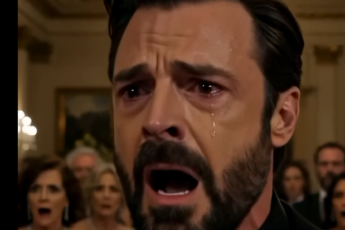
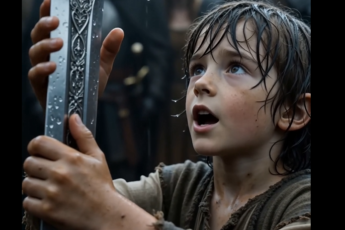
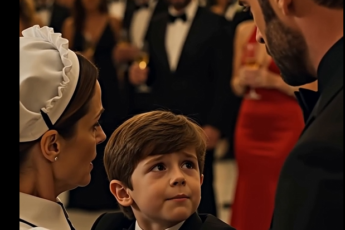
The royal feast had begun before sunset, but by midnight the castle hall still burned with golden light.
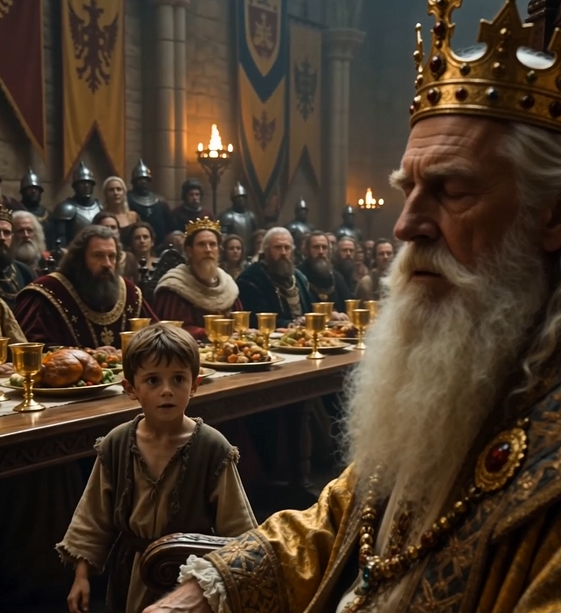
Torches flickered against stone walls. Red banners hung from the high ceiling. Nobles drank from golden cups, knights stood proudly beside the pillars, and servants moved between long wooden tables carrying roasted meat, fruit, and wine.
At the far end of the hall sat King Aldric.
He was old, powerful, and feared across seven kingdoms. A silver crown rested on his white hair, and a dark velvet robe covered his weak shoulders. But behind his power was a sorrow everyone knew.
The king was blind.
For forty years, he had ruled a kingdom he had never seen. He had never seen the faces of his people, the color of his banners, or the great stone castle built in his name. He knew the world only by footsteps, voices, and silence.
That night, nobles had gathered to celebrate the king’s final victory over his enemies. The hall was filled with laughter.
Then the doors opened.
A poor child stepped inside.
He was no more than eight years old. His clothes were torn, his feet were bare, and dust covered his small face. The guards immediately reached for their swords, and the nobles turned in disgust.
But the child did not look afraid.
He walked slowly through the hall, past the tables, past the knights, past the whispering lords and ladies, until he stood before the throne.
The hall became silent.
The child looked up at the blind king and said, “Your Majesty, I can help you see again.”
A wave of laughter moved through the nobles.
One lord raised his cup and mocked, “A beggar child will heal the king? Then perhaps he can turn stone into gold as well.”
But King Aldric did not laugh.
He leaned forward on his throne.
“Who are you, little one?” he asked.
The child’s voice was soft.
“Someone who came when you finally needed the truth.”
The king frowned. “The truth?”
The child stepped closer and held out his hand.
“Give me your hand, Your Majesty.”
The captain of the guard moved forward. “Stay away from the king.”
But Aldric lifted one finger, and the guards stopped.
Something in the child’s voice touched a place inside him that no priest, doctor, or magician had ever reached.
Slowly, the blind king extended his hand.
The child took it gently.
Then he began to count.
“One…”
The torches along the wall bent in the same direction, though no window was open.
The nobles stopped smiling.
“Two…”
The golden cups on the tables began to tremble. The banners moved as if a storm had entered the hall. A strange warm light appeared around the child’s fingers.
The king’s breathing changed.
For the first time in his life, he felt something like sunrise behind his closed eyes.
“Three…”
A golden flash filled the throne hall.
The nobles cried out. Knights dropped to one knee. Servants covered their faces.
King Aldric gasped.
His hands gripped the arms of his throne. His eyes opened slowly, painfully, as though they were learning the world for the first time.
And then he saw.
He saw fire.
He saw stone.
He saw gold.
He saw the faces of the nobles who had lied to him for years.
His lips trembled.
“Impossible…” he whispered.
The hall erupted in shock.
But the king did not look at the banners, or the torches, or the crown jewels shining beside him.
He looked only at the child.
The boy’s face was dirty and thin, but his eyes were bright—too familiar, too impossible. The king leaned forward, his heart beating harder with every second.
“Who are you?” he whispered again.
The child reached into his torn coat and pulled out a small silver pendant.
The king froze.
It was shaped like a moon.
Many years ago, before the throne had made him cruel and suspicious, King Aldric had given that pendant to the woman he loved. Her name was Elara. She was not noble, not rich, not accepted by the royal court. When the council told Aldric she was a danger to the crown, he believed them.
He sent her away.
Later, they told him she had died.
The king had carried that guilt in darkness for half his life.
The child placed the pendant in the king’s hand.
“My grandmother said you would recognize this,” he said.
The king’s face went pale.
“Grandmother?” he breathed.
The child nodded.
“She told me the king was not born blind. She said he became blind the day he chose his crown over his heart.”
The words struck the hall harder than thunder.
The nobles looked at each other in fear.
Then the old king finally understood.
His blindness had never been a curse from birth. It had been a spell—placed not by an enemy, but by the woman he had betrayed. Not to punish him forever, but to keep him from trusting the faces of liars.
His sight had returned only now because the last person who loved him without wanting power had come back to him.
His own blood.
The child was not a beggar.
He was the grandson the court had hidden from him.
King Aldric slowly stood from the throne.
For the first time, he saw the royal council clearly. He saw the fear in their eyes. He saw the guilt on their faces. He saw the same men who had stolen his love, his family, and his truth.
The king’s voice shook the hall.
“Remove their crowns. Take their rings. Open the prison cells beneath the east tower.”
The council fell to their knees.
One lord cried, “Your Majesty, please!”
But Aldric did not look away.
“I have been blind long enough.”
By dawn, the prisoners beneath the castle were freed. Among them were servants, healers, and old friends of Elara who had been silenced for decades.
But the greatest surprise came in the deepest cell.
There, weak but alive, sat an old woman with silver hair and a moon-shaped mark on her wrist.
Elara.
The king entered the cell alone. For the first time in forty years, he saw the face of the woman he had loved.
She looked at him quietly.
“You can see now,” she said.
Aldric fell to his knees.
“No,” he whispered, weeping. “Only now.”
That morning, before the entire kingdom, King Aldric removed his crown and placed it not on his own head, but on the throne beside Elara.
Then he called the poor child forward.
The nobles expected him to name the boy prince.
Instead, the king knelt before him.
“My child,” he said, “you did not give me my eyes. You gave me the courage to use them.”
Years later, people still told the story of the beggar child who walked into a royal feast and healed a blind king.
But those who knew the truth told it differently.
They said the miracle was not that the king saw fire, stone, banners, and gold.
The miracle was that, for the first time in his life…
he finally saw the people he had failed to love.