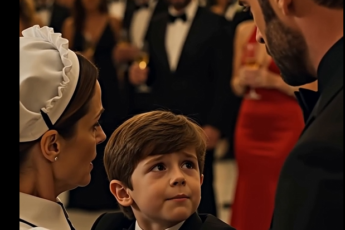
The pub was the kind of place decent people passed without looking twice. Its neon signs buzzed like tired insects in the smoky dark, its windows were stained amber with age and nicotine, and its regulars wore the sort of faces that made strangers lower their eyes and keep walking. At the far end of the bar, beneath a flickering beer sign and a mounted deer head with one broken antler, sat the man everyone simply called Boone.
He was enormous even while sitting down, his shoulders broad enough to block the light behind him. A jagged scar ran from the edge of his temple across his cheek and disappeared into his beard, which had gone mostly gray without softening him in the slightest. He had the dead-still posture of someone who had spent most of his life around danger and had long ago decided that if it came for him, it would find him ready.
No one bothered Boone when he drank. No one raised their voice around him. Even the loudest men in the room seemed to unconsciously lower themselves in his presence, as if the air near him carried its own rules.
That was why the room noticed the boy the moment he stepped inside.
He couldn’t have been older than seven. His hoodie was too thin for the night, his sneakers were muddy, and his chest rose and fell in quick, frightened bursts, as though he had been running for a long time and had only just remembered to be afraid. He stood at the entrance for half a second, scanning the room with wide eyes, then pushed forward between leather jackets and bar stools as though he had chosen his destination before he ever opened the door.
He went straight to Boone.
The murmur in the pub thinned into silence.
Boone turned his head only slightly as the boy stopped beside him. Up close, the child looked even smaller, like something misplaced, like a sparrow that had flown into a slaughterhouse by mistake.
The boy leaned in close and whispered, his voice trembling so badly the words nearly broke apart.
“They’re following me,” he said. “Please help.”
For the first time that night, Boone lifted his glass away from his mouth without drinking. He turned his full gaze on the child, and the scar across his face seemed to harden.
“Who are you?” he asked.
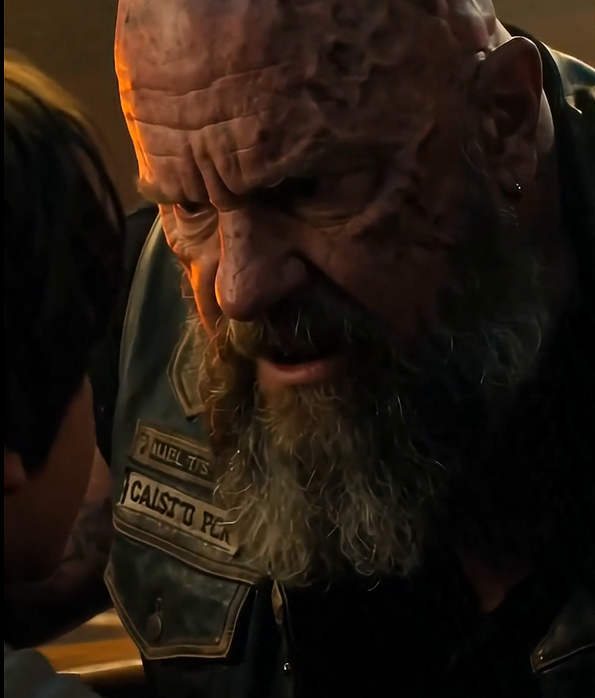
The boy swallowed. His lower lip quivered, but he held Boone’s stare with a strange, desperate courage.
“My father told me to find you if I was ever in trouble.”
Something unreadable moved behind Boone’s eyes, but his expression did not change.
“Who’s your father?” he asked, his voice lower now.
The boy took a breath that sounded too large for such a small body.
“Charles Harrelson.”
The glass slipped from Boone’s fingers and struck the wooden bar with a hard crack before rolling onto its side. Whiskey spilled like liquid amber across the counter. Around them, every sound in the room seemed to die at once.
Boone stared at the boy as though a ghost had just spoken through him.
No one in that bar could have known what that name meant to him.
Not the young men at the pool table. Not the bartender polishing a glass that no longer needed polishing. Not the old bikers pretending not to listen.
But Boone knew.
He had last heard that name twenty-one years earlier, in a prison infirmary that smelled of bleach and blood. Charles Harrelson had been half-conscious and grinning through broken teeth, his shirt soaked red where a shiv had opened him from side to side. Boone had held his hand over the wound while the guards ran late, and Charles, laughing softly as if death were only a bad joke, had grabbed Boone’s wrist and said, If blood of mine ever comes to you, you don’t ask questions. You move. Fast.
Boone had laughed then, because men like Charles always spoke as though life would keep making room for them.
But now there was a trembling boy in front of him, and the dead had apparently decided to collect old promises.
The pub door burst open.
Cold air rushed in, along with three men in dark jackets. They were not bikers. Their hair was too neat, their boots too clean, their eyes too alert. One of them held up a phone with a photo on the screen and scanned the room. When his gaze landed on the child, his face changed.
“There he is.”
Boone was already moving.
He grabbed the boy by the shoulder, not roughly, but firmly enough to pull him off balance and behind his massive frame. With his other hand, Boone lifted a barstool and sent it skidding across the floor into the first man’s knees. The man crashed sideways, taking a table with him. Shouts erupted. Someone reached under a jacket. Someone else ducked. A bottle shattered against the wall.
“Kitchen!” Boone barked at the bartender.
The bartender, who had known Boone long enough not to ask questions, shoved open the half-door behind the bar.
Boone pulled the boy through it.
They ran through a cramped kitchen filled with grease and steam, knocking over a rack of pans that clattered like gunfire. Behind them came curses, pounding footsteps, and the sharp metallic scream of a back door being kicked open. Boone shoved the boy into the alley, where rain had begun to fall in cold, slanting sheets.
At the end of the alley waited Boone’s motorcycle, black and heavy as a warhorse.
“Can you hold on?” Boone asked.
The boy nodded, though his face had gone pale.
“Then hold on like your life depends on it,” Boone said. “Because tonight it does.”
Moments later, they were roaring into the dark.
The road unwound beneath them in silver ribbons, wet with rain and lit only by the pale wash of moonlight and the occasional passing truck. The boy pressed himself against Boone’s back so tightly Boone could feel every shiver. They rode for nearly an hour without speaking, leaving the town, the pub, and whatever men were hunting them far behind.
At last Boone turned off the highway and followed a gravel road deep into a pine forest. There, hidden among the trees, stood a cabin few people knew existed. He killed the engine, listened for pursuit, and heard only the rain tapping softly through the branches.
Inside, the cabin smelled of old cedar and dust. Boone lit a lamp. The warm light revealed the boy’s exhaustion more clearly now. He looked as though he might collapse at any moment, but his eyes remained wide and watchful.
Boone set a kettle on the stove and then crouched in front of him.
“Start talking,” he said. “Everything.”
The boy hesitated. Then he reached into the pocket of his hoodie and pulled out a small envelope, damp but intact.
“He told me to give you this,” he said.
Boone frowned. “Who told you?”
“My father,” the boy said. “Before he died.”
The room seemed to shrink around those words.
Boone took the envelope and turned it over in his hand. On the front, written in faded black ink, was a single word: Boone.
His chest tightened.
He opened it carefully. Inside was a folded letter and an old photograph.
Boone looked at the photograph first.
It showed a young woman with laughing eyes and windblown hair standing beside a much younger Boone, before the scar, before the prison years, before time had made him look carved from stone. Her hand was on her stomach, and she was smiling the secret smile of someone who knows something the camera does not.
Boone’s breath caught.
“Lena,” he whispered.
He unfolded the letter with suddenly unsteady fingers.
Boone,
If you are reading this, then the worst has happened and the boy made it to you. I’m not asking you to forgive me. Lord knows I never earned that. But you deserve the truth at last.
The child is not mine.
He is yours.
Lena found me three months before she died. She was sick, scared, and too proud to come looking for you after all those years. She made me swear I’d keep the boy safe and that, if danger ever found us, I would send him to the only man she believed would die before letting harm reach him.
His name is Noah. He has your eyes. If there is any good left in either of us, let it live in him.
—Charles
Boone read the letter twice, then a third time, as if the words might rearrange themselves into something less impossible. His huge hands trembled. Across from him, the boy watched silently.
“What did you say your name was?” Boone asked at last, though he already knew the answer.
The child lowered his eyes.
“My real name is Noah,” he said softly. “Charles told me not to say it until we were alone.”
Boone stared at him, at the shape of his face, the line of his brow, the stubbornness in his mouth. And now that he was looking, really looking, he saw it. Not Charles. Not Lena.
Himself.
He sat down slowly in the nearest chair as though his legs had given way beneath him.
“I didn’t know,” he said, but he was not sure whether he was speaking to the boy, to Lena, or to the years that had stolen so much.
Noah stepped closer. “Are they going to find us?”
Boone lifted his head. The brutal man from the pub was still there, but something had shifted deep inside him, like a locked room opening after decades in darkness.
“No,” he said.
It was only one word, but it carried the weight of an oath.
He rose, crossed the room, and opened an old metal box hidden beneath a loose floorboard. Inside were cash, papers, two pistols, and a worn sheriff’s badge.
Noah stared. “You’re a cop?”
Boone looked down at the badge, then gave a short, humorless smile.
“I am now.”
Noah blinked in confusion.
Boone tucked the badge into his jacket and loaded the pistols with calm, practiced hands. Then he looked at the boy and said the last thing Noah expected to hear.
“The men chasing you aren’t bounty hunters, and they aren’t after Charles. They work for me.”
Noah stepped back, fear flashing across his face.
Boone raised a hand gently. “Listen to me. For the last six years, I’ve been an undercover federal witness inside a trafficking ring Charles helped expose before he died. I thought he disappeared with the evidence. I never knew he was hiding you.”
The cabin fell silent except for the soft hiss of the stove.
Boone’s eyes darkened as he glanced toward the window and the forest beyond it.
“They weren’t trying to kill you,” he said. “They were trying to get to you before the men who really want you did.”
Noah’s voice came out barely above a whisper. “Why would anyone want me?”
Boone folded Charles’s letter and slipped it into his pocket.
“Because,” he said, “if Charles trusted you enough to send you here, then somewhere along the way he gave you something worth hunting for.”
Noah’s face changed.
Slowly, carefully, he reached into the lining of his hoodie and tore open a hidden seam. From inside, he pulled a tiny flash drive wrapped in plastic.
Boone stared at it for a long moment.
Then, outside in the darkness, headlights appeared between the trees.
And for the first time in years, Boone smiled like a man who was no longer running from his past, but riding straight into it.
“Get your coat, son,” he said. “This is where the real story begins.”