The throne hall of Blackthorn Castle had always been built to make men feel small.
Its stone walls rose high into darkness, where torch smoke gathered beneath the wooden beams like storm clouds trapped indoors. Red and black banners hung between iron sconces, each one marked with the crowned wolf of King Aldric’s house. Armored guards stood along the walls without moving, their helmets shining in the firelight, while nobles whispered in careful voices, knowing that in this hall even a careless breath could be mistaken for betrayal.
At the far end, on a throne carved from dark oak and blackened steel, sat King Aldric.
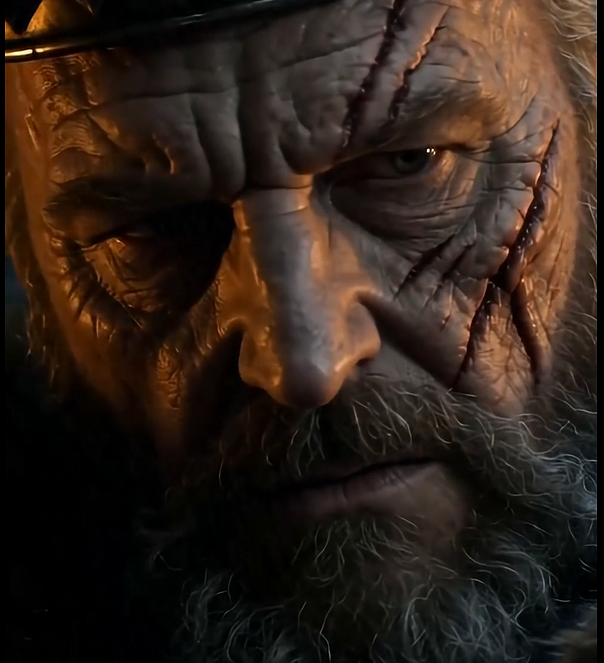
He was old, but no one in the kingdom mistook age for weakness. His gray beard fell over a heavy fur cloak, and a scar cut down the left side of his face from brow to jaw, leaving one eye colder and paler than the other. He had ruled for nearly thirty years, not with love, but with fear, silence, and the memory of what happened to those who stood against him.
That night, the court had gathered for judgment.
A captured rebel knight knelt in chains before the throne, accused of helping enemies cross the northern border. The nobles watched with tense interest, not because they cared about the prisoner, but because everyone knew the king had grown suspicious in his final years. A man could lose his head for a rumor. A family could lose its lands for a whisper.
King Aldric lifted one hand, and the hall went silent.
Before he could speak, the great doors at the back of the hall burst open.
A small boy ran inside.
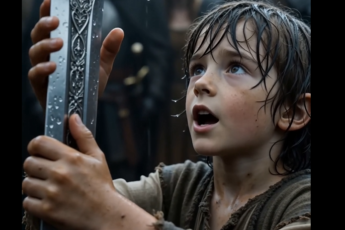
The guards reached for their swords, but the child was already past them, slipping between startled nobles with desperate speed. He could not have been more than seven. His clothes were torn, his bare knees were scraped bloody, and his messy hair clung to his forehead with sweat and rain. He looked over his shoulder again and again, as if death itself were only a few steps behind him.
No one moved.
The boy ran straight toward the throne.
A guard lunged to stop him, but the child ducked under his arm and stumbled onto the bottom step below the king. For a moment, the entire hall seemed frozen by the strange sight of this trembling peasant boy standing before the most feared ruler in the land.
The boy looked up at King Aldric, his face pale with terror, and whispered, “They’re following me… please help.”
A murmur spread through the nobles.
King Aldric did not move at first. He looked down at the boy as though he were an insect that had somehow crawled onto his royal table. Then his pale eye narrowed.
“Who are you?” the king asked.
His voice was low, rough, and dangerous, the kind of voice that made men confess before they even understood the crime.
The boy swallowed hard. His hands were shaking, but he forced himself to answer.
“My father told me to find you if I was ever in trouble.”
Something changed in the hall.
It was not something anyone could point to exactly, but the guards seemed to stand straighter, and the nobles seemed to lean closer. Even the chained rebel knight lifted his head.
King Aldric slowly leaned forward on his throne.
“Who is your father?”
The boy’s lips trembled. For one heartbeat, he looked as though he might run. Then he raised his chin and spoke the name.
“William Wallace.”
The hall died into silence.
Not quiet. Silent.
A torch cracked somewhere along the wall, and the sound seemed impossibly loud.
King Aldric’s face lost its color. His fingers tightened around the carved armrest of his throne until the old wood creaked beneath his grip. For the first time in many years, the nobles saw something in their king’s eyes that none of them had ever expected to see.
Fear.
William Wallace had been dead for twelve years.
At least, that was what every child in the kingdom had been taught. He had been called rebel, traitor, butcher, and madman in the king’s official histories, but in secret, among the poor and the beaten, his name was spoken differently. To them, Wallace had been the only man brave enough to stand against Aldric when the king burned villages, stole lands, and filled the roads with hanging bodies.
The king had ordered Wallace captured.
The king had ordered Wallace executed.
And the king had personally displayed his sword above the castle gate as a warning to anyone who dreamed of freedom.
So when this small boy claimed to be William Wallace’s son, every person in the throne hall understood that he was either lying, mad, or carrying a secret powerful enough to shake the kingdom.
King Aldric rose slowly from his throne.
“Bring him to me,” he said.
Two guards grabbed the boy by the arms, but the child did not cry out. He only stared at the king with wide, frightened eyes as they dragged him up the steps.
The king crouched slightly, bringing his scarred face close to the boy’s.
“William Wallace had no son,” Aldric said.
The boy reached into the torn lining of his tunic and pulled out a small piece of cloth, folded tightly and tied with a leather string. The guards tried to snatch it from him, but the king raised one hand, stopping them.
With shaking fingers, the boy opened the cloth.
Inside lay a silver ring.
The hall gasped.
It was not an expensive ring, not compared to the jewels worn by the nobles, but its meaning was greater than gold. On its face was carved the mark of a broken crown beneath a rising sun, the secret symbol Wallace’s rebels had carried during the war.
King Aldric stared at it as though the dead had placed a hand around his throat.
“Where did you get that?” he asked.
“My mother kept it,” the boy said. “She said my father gave it to her before the last battle.”
The king’s jaw tightened. “Your mother lied.”
The boy shook his head. “She said you would say that.”
A dangerous stillness passed over Aldric’s face.
The nobles looked at one another. No one dared speak, but every eye in the hall was fixed on the child.
The boy reached again into his tunic and pulled out a folded letter, sealed with old red wax. The seal was cracked from age, but the mark was still clear.
A crowned wolf.
King Aldric’s own royal seal.
The king’s expression changed again, not with fear this time, but with recognition.
He snatched the letter from the boy’s hand and broke it open.
The hall waited while he read.
At first, his face remained hard. Then his brow twitched. His mouth tightened. By the time he reached the final lines, the hand holding the paper had begun to tremble.
The boy whispered, “My mother said you wrote it.”
Aldric looked at him.
For a long moment, the old king said nothing.
Then he turned to the guards and shouted, “Clear the hall.”
The nobles froze.
“My king—” one of them began.
“Clear the hall!” Aldric roared.
The guards obeyed at once. Nobles were pushed back toward the doors, protesting in frightened whispers. The chained rebel knight was dragged away. Servants disappeared through side passages. Within minutes, the great throne hall was almost empty, leaving only the king, the boy, and a handful of trusted guards.
But before the doors fully closed, one noble saw the king do something no one would believe later.
He knelt.
King Aldric, ruler of Blackthorn, conqueror of the north, the man who had never bowed to priest, prince, or enemy, lowered himself to one knee before the child who had spoken William Wallace’s name.
The boy stepped back, startled.
The king’s face looked suddenly older, as though the years he had hidden from the world had returned all at once.
“What was your mother’s name?” Aldric asked.
“Elena,” the boy said softly. “Elena of Glenmoor.”
The king closed his eyes.
The name struck him harder than any sword ever had.
Elena had not been just a woman from a conquered village. She had been the only person Aldric had loved before the crown turned him into something colder. Long before he became king, before the war, before Wallace became his greatest enemy, Aldric had promised Elena he would return for her.
He never did.
He chose power instead.
And when the rebellion began years later, he discovered that Elena had married William Wallace, the man who gave the poor the courage Aldric had stolen from them. From that day forward, Aldric hated Wallace with a rage that was easier to understand than grief.
The king looked down at the letter in his hand.
It was not addressed to the boy.
It was addressed to him.
The writing was Elena’s.
If this child ever stands before you, Aldric, do not punish him for the sins of men. You and William both believed you owned my heart, but neither of you ever asked what truth I carried. I let the world believe the boy was Wallace’s son because that name could protect him among the poor. But blood has a way of finding the throne, whether kings want it or not.
Aldric’s breathing became heavy.
He read the final sentence again.
His name is Rowan, and he is yours.
The king slowly lowered the letter.
The boy stared at him, confused and afraid.
“Why are you looking at me like that?” Rowan asked.
Aldric could not answer at first. He had spent twelve years believing he had destroyed the last living piece of the woman who once loved him. He had turned her husband into a legend, hunted her people, and built his kingdom on ashes, never knowing that somewhere beyond his walls, his own son was growing up hungry, hunted, and taught to fear his name.
Outside the hall, a horn sounded.
Then another.
A guard rushed in, breathless and pale.
“My king,” he said, “armed men have entered the lower courtyard. They carry Wallace banners.”
Aldric stood slowly.
The boy turned toward the doors in terror. “Those are the men following me.”
The guard drew his sword. “Rebels.”
But Rowan shook his head.
“No,” he whispered. “Not rebels.”
The king looked at him.
The boy’s voice trembled as he continued.
“My mother said if I came here, they would come too. She said the men chasing me were not trying to kill me.” He looked up at Aldric with tears in his eyes. “They were making sure I reached you.”
The old king went still.
From beyond the great doors came the sound of hundreds of voices rising in the courtyard below. Not shouting for blood. Not calling for war.
Chanting.
“Wallace’s son! Wallace’s son!”
Aldric’s face darkened as he understood the truth too late.
The boy had not come to beg for protection.
He had been sent as a key.
The rebels knew the king would never harm a child carrying Wallace’s name in front of the court. They knew the nobles had seen his fear. They knew the rumor would spread before sunrise. And now, with half the kingdom gathered at the castle gates, they had brought Aldric something more dangerous than an army.
They had brought him an heir the people would love more than him.
Rowan stepped away from the throne.
From under his torn tunic, he pulled out one more thing: a small iron pendant shaped like a broken crown.
Aldric stared at it.
“That belonged to Wallace,” he said.
Rowan nodded. “He gave it to my mother. She told me to show it only when I found the man who feared both his name and mine.”
The throne hall doors began to shake as the crowd outside pushed forward.
The guards looked to Aldric, waiting for an order.
Kill the boy.
Hide the letter.
Crush the rebellion.
Do what he had always done.
But the king did not speak.
He looked at Rowan, and for the first time in his life, he saw not a threat, not a mistake, not a weapon used by dead enemies, but a child who had crossed darkness carrying the weight of every lie the kingdom had been built upon.
Then Aldric removed the iron crown from his head.
The guards stared in disbelief.
Rowan’s eyes widened.
The king placed the crown on the lowest step of the throne, not on the boy’s head, not yet, but between them, where both could see it.
“I killed William Wallace,” Aldric said quietly. “But I did not kill what he began.”
The doors burst open.
Rebels, guards, nobles, and servants flooded the hall at once, swords raised and voices rising, but all of them stopped when they saw the old king standing without his crown and the small boy beside the throne.
Aldric turned to the crowd.
“You came for Wallace’s son,” he said, his voice echoing through the hall. “But you have found mine.”
A shocked murmur swept through the room.
Rowan looked up at him, stunned.
Then the king did the one thing no one expected.
He bowed his head to the boy.
Not as a father.
Not as a ruler.
But as a man finally surrendering to the truth.
And in that moment, the kingdom changed forever.