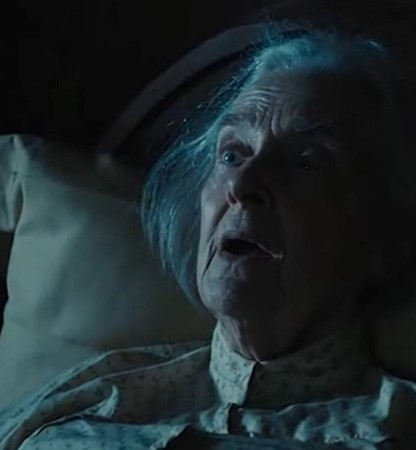
For nearly three years, my mother-in-law, Doña Remedios, had been bedridden after a severe stroke. Our home had grown used to the rhythm of her care—the quiet mornings, the muted footsteps, the unchanging routine that wrapped the house like a soft blanket. My husband worked long shifts, and most of the caregiving fell to me. Still, we stayed, partly out of duty, partly out of love, and partly because Remedios had once held our family together in ways we never fully appreciated.
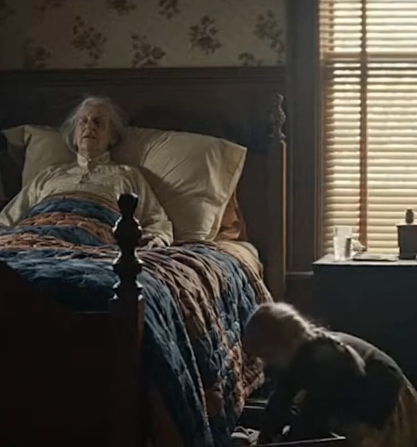
My five-year-old daughter, Sofía, often followed me on my rounds. She said she liked “keeping Grandma company,” but I suspected she was fascinated by the silence of that dim, old-fashioned room where time seemed almost frozen.
One afternoon, while I changed the sheets, Sofía slipped to the far side of the bed and started digging playfully through the folds of the blankets.
Suddenly she gasped.
“Mommy, look what I found!”
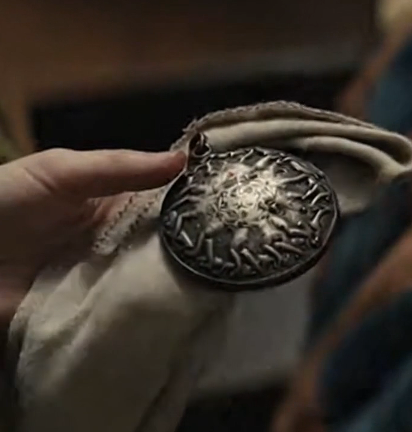
I turned quickly. In her small hands was a bundle wrapped in a faded handkerchief. When I took it, an unexpected chill shot through me.
The cloth was embroidered with initials I didn’t recognize: M.A.C.
Inside lay a silver pendant—old, heavy, strangely cold to the touch. It was engraved with an unfamiliar circle surrounded by distorted shapes that looked almost human, but not quite.
As I lifted it to the light, something felt wrong.
Then I heard a sound—a soft, raspy breath.
Remedios was staring at me.
Her eyes, usually empty and unfocused, were alert. Aware. Terrified.
And every bit of that fear was directed at the pendant in my hand.
For the first time since her stroke, her lips trembled.
In a voice dry and thin, she whispered:
“Don’t… open it.”
I froze. The pendant had a small hinge I hadn’t noticed before.
That night, when everyone was asleep, I sat in the kitchen studying the pendant. I felt foolish, anxious, and unbearably curious. The initials didn’t match anyone I knew in the family.
Then I remembered the attic—my husband’s family storage, untouched for decades.
I climbed up with a flashlight, coughing at the dust. After rummaging through old boxes, I found a stack of brittle letters tied with ribbon.
The initials matched the signature:
María del Carmen.
Remedios’s younger sister.
In the letters, María wrote about being afraid of someone she called el desconocido—the stranger. She described nightmares, cold spots in the house, whispers at night.
The last letter ended abruptly:
“If anything happens to me, don’t let them open the pendant.”
The same pendant sitting in my hand.
The next morning, I confronted my husband, but he brushed it off.
“My mother had a hard life,” he said. “She lost her sister young. That’s all.”
But Remedios heard us.
She began to cry—silently, but with tears that slid down her cheeks as if decades of memories were finally breaking through.
She reached for my hand and whispered,
“Please… finish it. Please.”
I didn’t know what “finish it” meant then. But later that night, while cleaning the kitchen, I finally felt the hinge of the pendant move under my thumb.
I didn’t open it—
but I understood something:
It wasn’t meant to be kept.
It was meant to be returned.
And I suddenly knew exactly where.
The place María mentioned in her letters over and over:
the old olive grove behind the house.
At dawn, I helped Remedios into a wheelchair and took her outside. The air was cold but calm. She clutched my arm the entire way, trembling with fear and something else… relief.
We reached the grove.
Among the trees stood a single, crumbling stone marker—almost invisible under moss.
I placed the pendant at its base.
Remedios closed her eyes.
The wind stirred, gentle and warm, as if the earth itself exhaled.
A peace settled over her face—a peace I had never seen.
“Thank you,” she whispered.
Her head rested against my shoulder.
And in that moment, quietly, without pain—
she passed.
Later, while sorting through her papers, I discovered the truth.
María had died suddenly at eighteen.
The pendant was her only keepsake.
Remedios believed that returning it to her sister’s resting place would free María from whatever tormented her final days.
She had carried that guilt for decades.
And when the pendant finally returned home…
so did she.
Now, whenever I pass the olive grove, the air feels softer. Lighter.
And Sofía—bright, intuitive Sofía—once told me:
“Grandma smiles here.”
For the first time, I believed her.