The evening at La Marée restaurant was perfect.
Crystal glasses shimmered in the soft golden light. A live violin played near the window overlooking the river. The waiters moved silently, like shadows, and the guests spoke in hushed voices—the way people do when they are used to expensive places and expensive secrets.
At the center table sat Victoria Laurent.
Everyone knew her.
At thirty-six, she was the face of an elite cosmetics brand, a regular guest at charity galas, a woman whose photographs appeared constantly in glossy magazines. Perfect posture. Perfect makeup. Perfect smile.
But tonight, her smile was forced.
She was waiting for someone she had not seen in twenty years.
Her father.
Once, he had vanished from her life without explanation. He had simply left. No letter. No phone call. No attempt to come back.
And this morning she had received a short message from an unknown number:
“I need to see you. Just once. Please.”
At first, she wanted to delete it.
Then she wanted to refuse.
But something inside her—something old and wounded—made her reply.
Now she sat by the window, gripping the stem of her glass so tightly her fingers turned white.
“Ma’am, would you like more water?” the waiter asked softly.
“No,” Victoria answered coldly. “I’m waiting.”
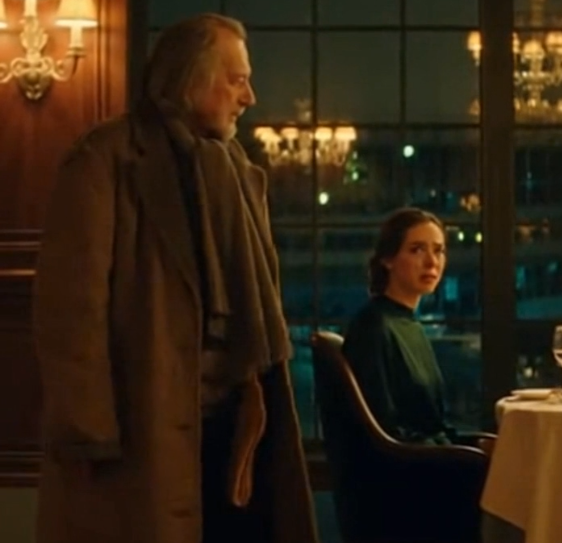
At that moment, the restaurant doors opened.
And an old man walked in.
He wore an old dark coat, too thin for the cold evening. His shoes were worn out. His hair was almost completely gray. He looked out of place among all this luxury, like a man who had wandered into the wrong life.
Some guests immediately turned to look.
Someone frowned.
The manager had already taken a step toward him, but the old man stopped on his own, scanning the room with an anxious gaze.
And then he saw Victoria.
She knew it instantly.
Even after twenty years.
Even through the wrinkles, the gray hair, and the exhaustion.
It was him.
André Laurent.
Her father.
He slowly walked toward the table.
“Victoria…” he said quietly.
Her heart slammed against her chest, as if trying to break free.
But her face remained icy.
“You’re twenty years too late,” she said.
The old man flinched.
“I know.”
“No,” she cut him off, lifting her eyes to his. “You don’t know. If you did, you wouldn’t have come here so calmly.”
The nearest tables were pretending not to listen.
But everyone was listening.
“Please, give me five minutes,” he begged. “Just five.”
Victoria slowly leaned back in her chair and looked at him as if he were not a person, but a mistake that should have been erased long ago.
“You left my mother when she was dying.”
“Victoria…”
“You left me when I was sixteen.”
“It wasn’t like that…”
“Then how was it?” Her voice grew louder. “Tell me. I’m curious. Were you tired of being a husband? Tired of being a father? Or did you just decide another life would be easier?”
The old man clenched his hands.
“I never wanted to leave either of you.”
She laughed.
But there was nothing alive in that laugh.
“Then why did you disappear?”
He tried to say something.
But Victoria was already standing.
Tall. Impeccable. Cold.
“No. You know what? Don’t. I don’t need explanations from a man who buried himself for me years ago.”
She turned to the manager.
“Please remove this man. He’s disturbing dinner.”
A murmur ran through the room.
The old man went pale.
“Victoria, please…”
She looked at him with such contempt that the waiter nearby lowered his eyes.
“Leave,” she said. “And never say my name again.”
The manager awkwardly stepped closer, touching the old man’s elbow.
He looked at his daughter for one more second.
Then he slowly pulled an old envelope from inside his coat.
He placed it on the table.
And said just one sentence:
“Then at least read this… after I’m gone.”
Victoria’s jaw trembled.
But she said nothing.
The old man turned and slowly walked toward the exit under the gaze of dozens of people.
When the door closed behind him, the restaurant became strangely quiet.
Even the violin seemed softer.
Victoria sat back down.
Her chest rose and fell heavily.
She stared at the envelope as if it might burn her.
A minute passed.
Then two.
Finally, she snatched it and tore it open.
Inside was a letter.
And a medical file.
On the first page, in shaky handwriting, were the words:
“If you are reading this, it means I did not have the courage to tell you everything face to face.”
Victoria frowned and kept reading.
“In the year your mother became sick, I was given another diagnosis. A rare form of heavy metal poisoning caused by an accident at the factory where I worked. The company paid me to stay silent. But there was more. Several families had already lost children. Your doctor told me clearly: if the truth came out too early, there would be lawsuits, panic, and revenge. You could have been harmed. I agreed to disappear and testify in a sealed case. I was forbidden from contacting you. If I broke that order, I would face prison and lose all witness protection. I thought I was saving you. Every day I hated myself for it.”
There were official documents after that.
Signatures.
Stamps.
Dates.
The name of a pharmaceutical group connected to the accident.
And then the last page.
Current diagnosis: terminal stage lung cancer.
Victoria’s hands began to shake.
She read the last line twice.
Then once more.
Her lips parted, but the air caught in her throat.
No.
No.
This couldn’t be true.
She shot to her feet so suddenly that her chair crashed to the floor.
“Where is he?!” she cried.
Everyone turned.
The manager lifted his head in confusion.
“Who, ma’am?..”
“The man who just left! Which way did he go?!”
“I… I don’t know, ma’am, he turned toward the riverwalk…”
But she was already gone.
Victoria ran out of the restaurant without her coat, without her bag, without the dignity she had always valued so much.
The cold air struck her face.
Her heels slipped on the damp pavement.
She ran along the riverwalk, breathless, looking desperately around.
“Dad!” she cried for the first time in twenty years.
Her voice broke.
Ahead, near a bench beneath a streetlamp, stood a familiar figure.
The old man turned.
And in that moment she saw that one hand was pressed against his chest.
He was breathing hard.
As if every breath hurt.
“Dad!” she cried again, running toward him.
He tried to smile.
A weak, guilty smile.
“You read it…”
And then his legs gave out.
She caught him before he hit the wet stone.
“No, no, no…” she whispered, sinking to her knees with him. “Please… not now… please…”
He looked at her with eyes clouded by pain.
“I didn’t want… you to find out like this,” he whispered.
Tears were already streaming down her face, washing away her perfect makeup.
“Why didn’t you tell me sooner?”
“Because you had the right… to hate me,” he said with difficulty. “But you did not have the right… to live in danger.”
She shut her eyes and shook her head.
Everything she had believed for twenty years was collapsing right now.
All her pain.
All her anger.
All the contempt she had carefully preserved as proof that she was right.
It turned out she had hated the man who had destroyed his own life trying to save hers.
“Call an ambulance!” she shouted to the people around them.
Someone was already calling.
But Victoria barely heard the voices.
She held her father’s head in her lap, stroked his gray hair, and repeated the same words like a prayer:
“I’m sorry… I’m sorry… I’m sorry…”
Slowly, the old man lifted a hand.
He touched her cheek.
“You look like your mother,” he whispered.
And for the first time in many years, Victoria did not cry beautifully.
Not quietly.
Not with restraint.
But truly.
Three days later, the whole city was talking about something else.
Not Victoria Laurent’s appearance at a charity gala.
Not her new contract.
Not even the scandalous restaurant video someone had managed to record.
But the press conference where she stood in a simple black suit, without jewelry, telling the truth about the accident that had been hidden for years.
Beside her sat lawyers.
And also her father—very weak, very thin, but alive.
He had survived that night.
And for the first time in twenty years, he sat beside his daughter not as a ghost from the past, but as a man who had finally been given the right to be heard.
The investigation was reopened.
The pharmaceutical group was accused of suppressing evidence.
Other families also got a chance to learn the truth.
But for Victoria, something else mattered more.
Every evening after the hospital, she went to see her father.
Sometimes they simply sat in silence.
Sometimes he told her what she had been like as a child.
How she was afraid of thunderstorms.
How she hid candy under her pillow.
How once she had said she would grow up to become “so strong that no one could ever take away the people she loved.”
Victoria listened and cried.
Because she had understood too late:
he had not left because he did not love her.
He had left because he loved her so deeply that he agreed to become a monster in her eyes.
Two months later, she closed her beauty foundation and opened a new one.
The Elena and André Laurent Foundation — for families torn apart by corporate crimes and witness protection programs.
At the opening, a journalist asked her:
“What was the most painful lesson for you?”
Victoria looked calmly into the camera.
But in her eyes was something that had never been there before.
Truth.
“Never humiliate a person whose story you do not know,” she said. “Sometimes behind someone’s silence is a love so great you could spend a lifetime trying to deserve it.”