It started like any other normal afternoon in suburban America.
The sun was out, kids were riding bikes, someone was arguing with a leaf blower, and at least one neighbor was definitely washing the same pickup truck for the third time that week.
Then somebody looked up.
At first, it seemed harmless. The Moon was visible in the daytime sky — unusual, but not exactly headline material. People pointed at it, took out their phones, and did what humanity always does in moments of historic significance: opened TikTok.
But within minutes, something felt wrong.
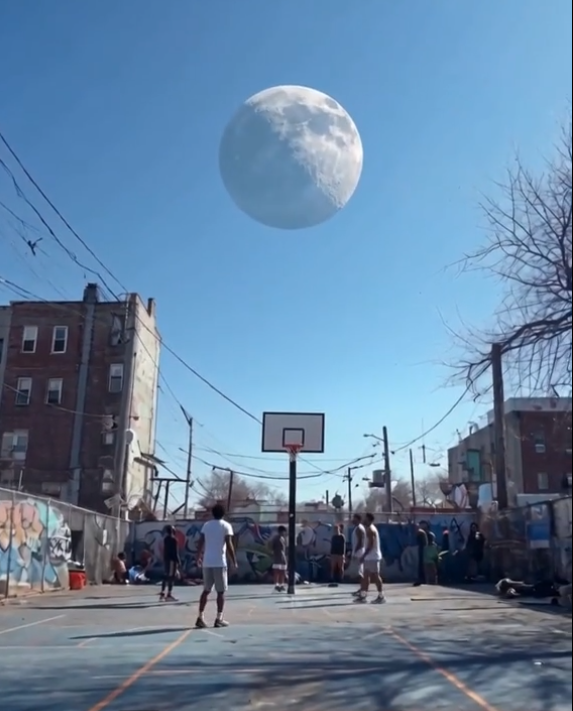
The Moon was getting bigger.
Not “wow, that looks strange” bigger.
Not “must be some weird optical illusion” bigger.
More like “why does the sky suddenly look personally offended” bigger.
Experts would later try to explain it with words like gravitational instability, orbital collapse, and planetary-scale catastrophe. But ordinary people had already come up with a much simpler description:
“Yeah… we’re cooked.”
As the Moon moved closer, the first signs of disaster rolled in fast. The ground began to shake. Windows cracked. Power lines swung like they were trying to escape. Car alarms started going off for no reason — which, to be fair, was probably the most realistic part of the whole event.
Neighbors ran outside in confusion, still holding coffee cups, garden hoses, and in one unforgettable case, half a sandwich. One man stared at the sky for a full five seconds before quietly saying, “I knew this week was gonna be bad.”
Social media, naturally, remained deeply committed to excellence.
Within minutes, the internet was flooded with videos titled:
- Moon Acting Weird In My Neighborhood??
- POV: Earth Is Basically Done
- Nobody Told Me Monday Would Be Like This
One woman continued filming even as roof shingles fell around her, because apparently the survival instinct now comes second to “getting content.”
Scientists warned that if the Moon truly approached Earth at that speed, the result would be catastrophic long before impact. Tidal forces alone would trigger massive earthquakes, structural collapse, and widespread destruction. In simpler terms: the planet would begin falling apart while everyone was still trying to decide whether this was real or some kind of government experiment.
It did not help that several people online insisted it was “probably AI.”
Meanwhile, in neighborhoods across the country, the mood shifted rapidly from curiosity to absolute panic. Streets filled with dust. Buildings began to crack. Distant sirens echoed through the city. And somewhere, somehow, a guy still found time to post:
“If the Moon hits during my shift, I’m still not coming in.”
Honestly? Fair.
There was something uniquely human about the whole thing. Faced with an extinction-level event, people screamed, prayed, ran, filmed vertically, and argued in comment sections. Civilization may have been collapsing, but the internet remained committed to being embarrassingly consistent.
And hanging above it all was the Moon — no longer a peaceful object in the sky, no longer poetic, no longer romantic. It was now an approaching nightmare, enormous, silent, and impossible to ignore.
For centuries, humanity looked at the Moon and wrote songs about it.
Now, as it rushed toward Earth like it had finally lost patience with all of us, one truth became painfully clear:
Maybe it had been watching for a long time.
And maybe it had simply decided it had seen enough.