The crowd had come for blood.
By the time the sun had climbed high above the stone walls of the arena, the heat had already settled over the sand like a curse. Thousands of voices rose and fell in waves, hungry for spectacle, hungry for death, hungry for the kind of ending Rome loved most—one man standing, another broken at his feet.
That morning, the games had already claimed enough lives to satisfy any ordinary crowd.
But this was not an ordinary day.
Because by the time the dust settled after the final clash, only one man remained standing.
A gladiator.
Bareheaded.
Breathing hard.
His body was covered in sweat, sand, and blood—some of it his, most of it not. Around him lay the men sent to kill him. One twisted in pain. Another was motionless. A third had dropped his weapon and crawled away before collapsing face-first into the dirt.
The surviving fighter did not raise his sword in triumph.
He did not shout.
He did not ask for mercy.
He simply stood there, looking upward.
Toward the imperial box.
Toward the man watching from above.
The emperor.
At first, the emperor leaned forward with the detached interest of a ruler who had seen too much violence for it to mean anything anymore. For him, gladiators were tools. Entertainment. Dust and flesh wrapped in iron. They rose and died without consequence.
But there was something about this one.
Something in the stillness.
In the way he held himself.
In the way he looked back.
Not like a slave.
Not like a survivor.
Like a man who had come for something.
The noise of the crowd slowly faded into a tense, unsettled murmur.
Then, in a voice that carried across the arena, the emperor called down:
“Who are you?”
The gladiator did not answer immediately.
Instead, he bent slowly and picked up the helmet lying near his feet—the one he had discarded before the last fight. He turned it once in his hands, as if remembering another life hidden inside it, then let it fall back into the sand.
When he raised his face again, the emperor saw him clearly.
And something changed.
The ruler’s expression hardened first, then faltered.
Because the face below was not unfamiliar.
It was older now. Sharper. Marked by pain and survival. But memory moved faster than time.
The gladiator spoke.
“I am the man you betrayed.”
The arena fell silent.
Not truly silent—no place like that could ever be silent—but the kind of silence that arrives when thousands of people realize they are seeing something they were never meant to witness.
The emperor rose slowly from his seat.
For one brief moment, no one in the crowd understood the meaning of the words.
But the emperor did.
Too well.
Years earlier, before the crown sat on his head, before the gold and purple robes, before the Senate bent to his will, there had been another man standing closer to power than anyone else.
General Lucian Varro.
The empire’s most feared commander.
The people loved him because he won wars no one else could win. The soldiers followed him because he bled beside them. Even the old emperor had trusted him.
And that was the problem.
Because the young prince—the man who now ruled as emperor—had understood something dangerous long before anyone else.
Rome could forgive cruelty.
Rome could worship ambition.
But Rome loved victorious men more than rightful heirs.
If Lucian returned from the eastern campaign with another triumph, the cheers would not belong to the prince.
They would belong to him.
So a plan was made.
Quietly.
Carefully.
No public accusation. No open conflict.
Only an ambush on the road home. Loyal men bought in secret. A report delivered to the capital before the blood had even dried.
General Lucian Varro had died in a barbarian raid.
His body was never recovered.
The city mourned him for a week.
Then moved on.
Or so the emperor believed.
But men like Lucian did not die easily.
That night, wounded and barely conscious, he had been dragged not by Roman hands but by traders who sold bodies the way others sold grain. They did not know who he was. They only saw value. A strong man with scars, rage, and a will to live.
He was sold south. Then east. Then back west.
A general became a slave.
A slave became a fighter.
A fighter became something else.
A legend whispered in training yards and underground betting circles—a man who never gave his real name, who killed with the discipline of a soldier and the patience of a hunter.
Years passed.
Empires shifted. Faces changed.
But one thing remained unbroken:
Lucian Varro remembered.
Not only the betrayal.
But the eyes of the man who ordered it.
And now, at last, those same eyes stared down at him from the imperial box.
The emperor recovered first.
He had spent too many years in power to lose control in front of a crowd.
“Seize him,” he said.
The order was immediate, sharp, final.
But the guards around the arena hesitated.
They had all seen the fight.
They had all heard the words.
And worse—many of them had heard the old stories.
Of the general who was supposed to have died.
Of the man the soldiers once believed should have ruled beside an emperor, not beneath one.
Lucian did not move.
He did not need to.
He knew this was no longer a contest of swords.
It was a contest of truth.
“You told Rome I died with honor,” he said, his voice steady, carrying farther than the emperor’s had. “But you did not send me to war. You sent me to be murdered.”
The crowd reacted like a living creature struck in the chest.
Confusion. Shock. Hunger.
The emperor stepped forward, fury returning now that fear had been seen.
“This man is lying,” he shouted. “He is a gladiator desperate to save his life.”
Lucian laughed once.
Not loudly.
Just enough.
“Then let me remove my armor,” he said, “and show them what desperate men do not carry.”
Slowly, under the burning eyes of the arena, he unclasped the broken armor at his shoulder and pulled it away.
There, across his upper chest, was a scar.
Long.
Jagged.
Old.
Not from the arena.
From a Roman blade.
And just beneath it, branded into his skin—not by fire, but by iron and rank from years before—was the mark of imperial command once given only to the empire’s highest general.
The people near the front saw it first.
Then the senators.
Then the soldiers.
The murmur turned into something else.
Recognition.
The emperor understood at once that the danger was no longer the man.
It was the memory he had brought back with him.
So he did what frightened rulers always do when truth begins to breathe.
He pointed, and he lied louder.
“Kill him!”
This time the guards moved.
Not because they wanted to, but because fear still obeyed the throne.
Several ran down into the arena. Spears lowered. Shields raised.
Lucian snatched a fallen trident from the sand with one hand and a short sword with the other. He moved like a man who had lived too long inside violence for it to surprise him anymore.
The first guard fell before reaching him.
The second lost his footing in blood and sand and died on his knees.
The third stopped.
And then something happened that no one had expected.
A voice rose from the soldiers near the lower gate.
Then another.
Then many.
Not a chant.
A name.
“Varro.”
The emperor turned sharply.
The old campaign veterans in the guard had begun to recognize him too.
Not just by face.
By movement.
By the impossible discipline of the way he fought.
These were men who had once marched under his command.
Men who had believed him dead.
Men who now stood between obedience and memory.
Lucian looked up one last time.
“Ask yourself,” he said to the emperor, “why the dead had to return for Rome to remember the truth.”
The emperor’s mouth opened, but no answer came.
Because deep down he knew the worst part was not that Lucian had survived.
It was that he had returned at the perfect moment.
The city was tired. The Senate was divided. The people were hungry for something to believe in. And nothing feeds rebellion faster than a man who was buried by power and walked back into the light.
The emperor made one final desperate choice.
He signaled the archers.
From above, hidden behind the stone railings, bows were lifted.
Not toward Lucian alone.
Toward the arena.
Toward the crowd if necessary.
Toward anyone.
That was when Rome understood what sat on the throne.
Not a ruler.
A frightened man with a crown.
The first arrow flew.
It never reached Lucian.
A guard—one of the emperor’s own—stepped in front of it.
Then another sword was drawn.
Not against the gladiator.
Against the men still loyal to the emperor.
Chaos exploded.
The arena that had been built for controlled death became something Rome feared more than blood:
choice.
Senators fled. Nobles screamed. The crowd surged. Soldiers turned on soldiers.
And in the middle of it all, Lucian did not run toward the emperor.
He walked.
Slowly.
Deliberately.
Until he stood below the imperial box, looking up.
The emperor backed away.
For the first time in years, there was no command in his face.
Only the naked terror of a man realizing that the past he buried had not come back for revenge.
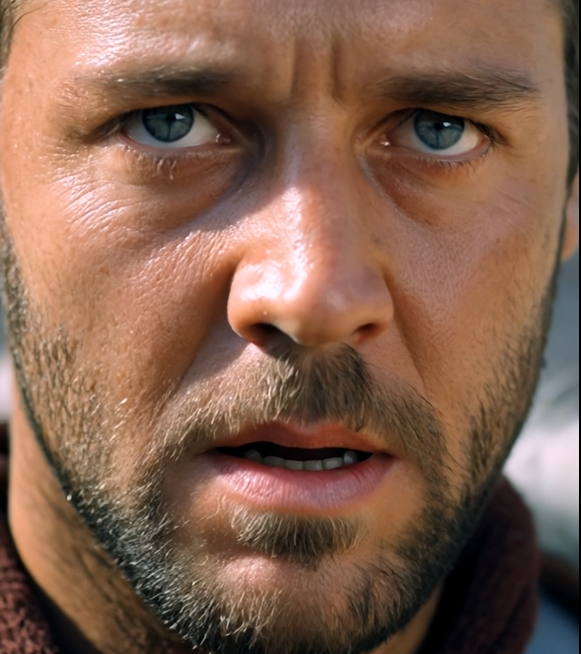
It had come back for judgment.
But Lucian never climbed the steps.
He never raised a weapon toward the throne.
Instead, he looked at the people of Rome—the same people who had been cheering for his death moments before—and said:
“I did not survive to become another tyrant.”
Those words traveled farther than any sword could have.
And that was the moment everything truly ended for the emperor.
Because the crowd expected slaughter.
Instead, they saw restraint.
They expected vengeance.
Instead, they saw a man offering Rome something it had not seen in too long:
honor.
By nightfall, the emperor had been abandoned by the Senate, deserted by half his guard, and locked inside his own palace under watch.
By dawn, the city was no longer his.
But the ending was stranger than anyone expected.
When the senators begged Lucian to take the throne, he refused.
When the people gathered outside the palace calling his name, he did not appear.
And when the gates of the gladiator quarters were opened at sunrise…
he was gone.
No servant saw him leave.
No soldier followed him.
No horse was taken.
It was as if the man who had returned from the dead only long enough to break an empire’s lie had simply stepped back into history once his work was done.
Years later, Rome would argue over what happened in that arena.
Some claimed Lucian became a wanderer.
Some said he was killed in secret by men still loyal to the old crown.
Some believed he stood in the crowd for years afterward, watching silently as Rome tried to become worthy of the truth he had dragged into daylight.
But the most beautiful version—the one mothers told their sons and old soldiers whispered over wine—was this:
That he had not come back to reclaim power.
He had come back to return it.
To the people.