The doors to the throne hall were not meant to open like that.
Not during the final hour of court, when the torches burned low and the day’s petitions had nearly ended. Not while nobles still stood arranged in careful ranks, and guards lined the stone walls in polished silence. The palace was a machine of order, and order did not make room for panic.
But panic entered anyway.
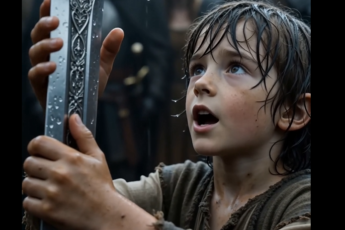
A little boy ran across the hall, breathless and pale, clutching a blood-stained cloth in both hands as if his life depended on not dropping it. He looked too small for the room, too poor for the marble beneath his feet, too terrified to have crossed so many guarded doors alone.
“My king…” he gasped. “My mother is dying.”
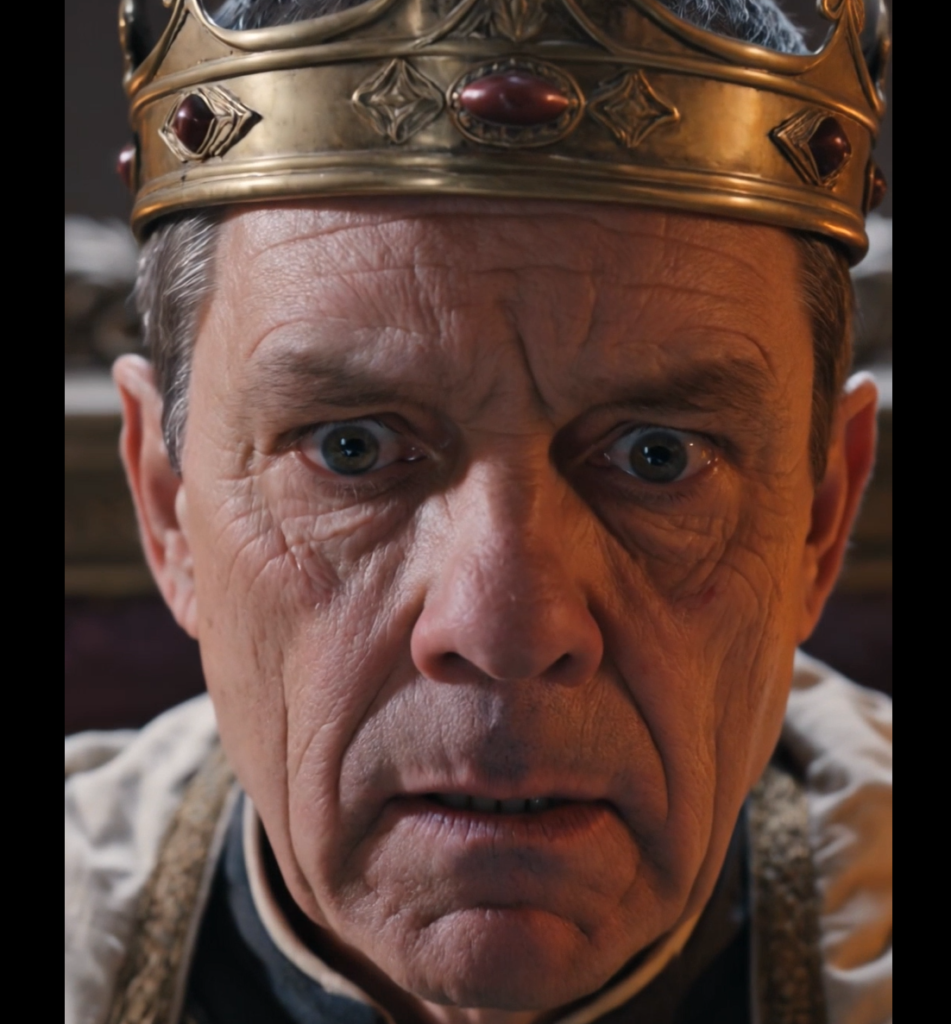
The nobles stirred in annoyance before concern. A few frowned. One old lord muttered that the guards had grown careless. But the king, seated high on the throne beneath banners of gold and crimson, did not speak at once.
He studied the child.
There was something strange in the boy’s eyes—not boldness, not madness, but the kind of desperate certainty that comes only when someone has repeated a final instruction a hundred times in fear of forgetting it.
“Why come to me?” the king asked at last.
The boy swallowed hard. His hands trembled so violently that the blood-stained cloth almost slipped.
“She said…” he whispered, “you would know this.”
He stepped closer and unfolded the cloth.
Inside lay a dagger.
It was not large. Not ornate. But no one in that room mistook what it was.
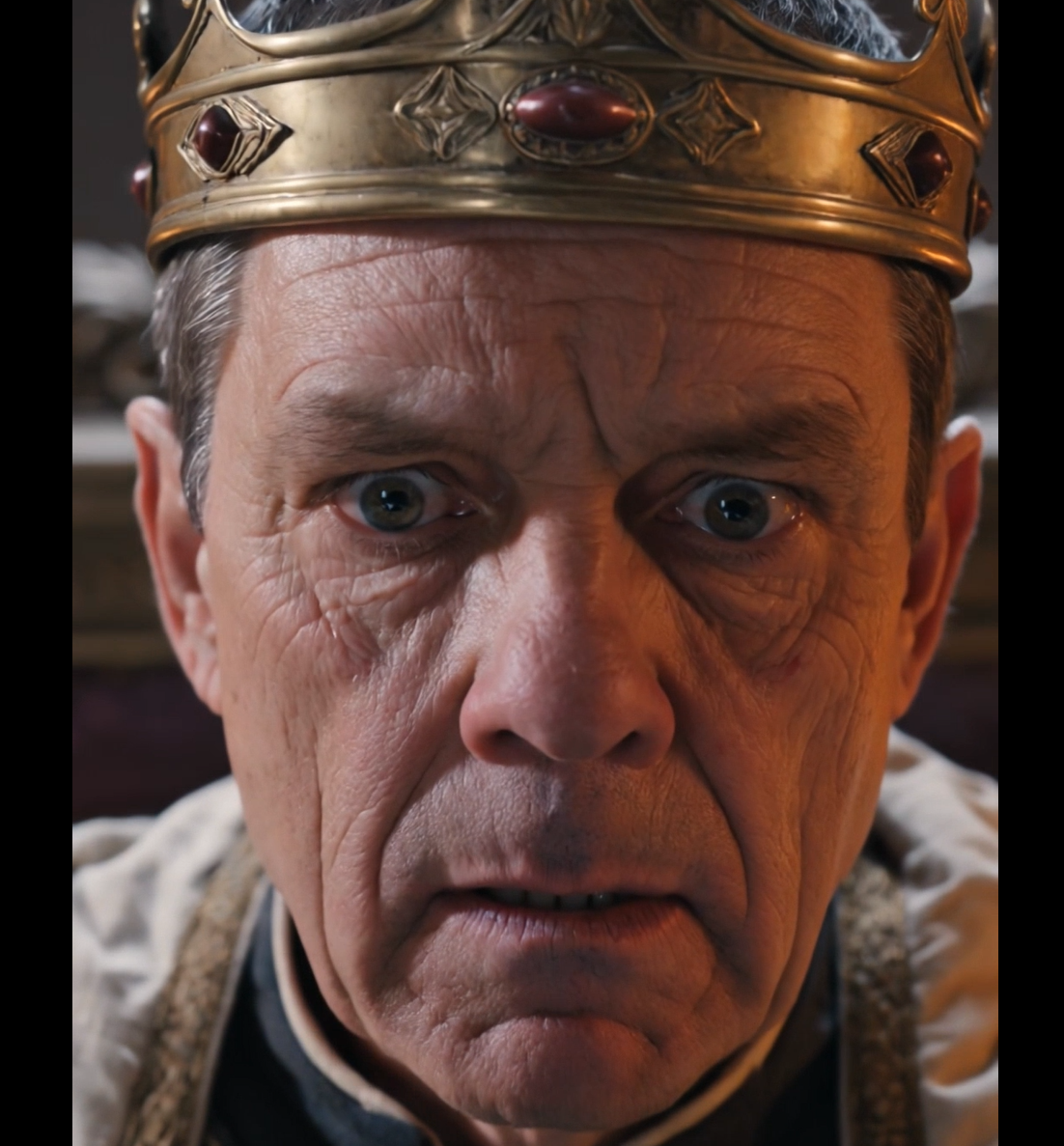
The king went still.
The hilt was dark silver, wrapped in faded black leather. Near the guard, etched so finely that most men would never notice unless they knew where to look, was the insignia of the old royal guard—used years ago, before the king wore a crown, before half the men in that hall had risen high enough to stand near him.
The king knew the weapon instantly.
He had not seen it in seventeen years.
“Where did she get that?” he asked, and for the first time his voice was no longer the voice of a ruler addressing a child. It was the voice of a man who had just heard the past breathe.
The boy’s eyes filled with tears.
“She said…” He hesitated, fighting to keep the words steady. “She said you left it the night you betrayed her.”
Silence spread through the hall like winter.
The king rose so abruptly that the nearest guards instinctively reached for their swords. His face had not lost control exactly, but something had cracked behind it—something the court had not seen in years, perhaps ever.
“Clear the hall,” he said.
No one moved quickly enough.
His voice dropped lower.
“Now.”
The nobles bowed and retreated at once. Guards drove servants out. The great chamber emptied in a rush of cloth and armor and frightened silence until only the king, the boy, and two trusted guards remained at the doors.
The king descended the steps slowly.
He stopped before the child and stared at the dagger again.
Once, long ago, it had been his favorite weapon. Not because it was royal, but because it wasn’t. It had been balanced for real use, not ceremony. He had carried it hidden beneath his cloak on nights when he still believed princes could move through the world unseen. He had lost it—or thought he had—on the worst night of his youth.
The night he never spoke of.
The boy looked up at him, frightened now not by the throne, but by the man standing before it.
“What is your mother’s name?” the king asked.
The boy hesitated.
Then he answered quietly.
“Mirelle.”
The name hit the king harder than the dagger itself.
For a moment, he could not feel the floor beneath him.
Because Mirelle had once been the one person in the capital who spoke to him as if he were not a future king, but simply a man capable of choosing his own soul.
She had been the daughter of a blacksmith in the lower quarter, though “blacksmith” barely described the family’s place in the city. Her father repaired armor for palace guards and forged tools for merchants and farmers alike. He was respected, poor, stubborn, and widely considered beneath the notice of princes.
His daughter was impossible to ignore.
She was not courtly. Not careful. Not impressed by rank. When the young prince first met her, she was standing in the forge doorway with soot on her cheek and a temper sharp enough to cut iron. He had come in disguise, restless and hungry for air beyond the palace, accompanying a guard captain who needed a sword repaired discreetly after a drunken fight. Mirelle had looked at him once and said, “If you’re not here to work, move. You’re blocking the light.”
No one had ever spoken to him that way.
He returned the next week.
Then again.
At first, he pretended it was for the city—for the noise, the freedom, the strange delight of not being bowed to. But it was always for her.
She laughed rarely, but when she did it undid him. She trusted slowly, but once she did, she offered honesty with a kind of fierce mercy he had never known in court. She saw through his disguises long before she admitted it, and when she finally told him so, she did not kneel or panic.
She only said, “Then that makes you more foolish than I thought.”
He loved her from that moment.
Not in the polished, poetic way bards described princes and beautiful women. He loved her like a man walking toward fire because warmth mattered more than fear. They met in alleys, empty courtyards, abandoned watch paths near the outer wall. He told her dreams he had never spoken aloud. She told him truths he had never wanted but always needed.
And because youth confuses intensity with invincibility, he believed that would be enough.
It never is.
When the old king discovered the affair, he did not rage. He did not imprison anyone. He did not need to. Men like him rarely shouted when they could arrange.
The prince was told, gently and firmly, that the future of the kingdom had already been decided. A royal marriage was being negotiated. The daughter of a northern house would bring soldiers, grain, and peace along the border. The prince’s desires were irrelevant next to the weight of a crown.
He argued. Refused. Threatened to renounce everything.
His father let him speak.
Then he said words the prince would spend years trying not to remember:
“You are free to ruin yourself. You are not free to ruin what thousands of men will inherit after you.”
Within days, the prince found his movements watched. Guards changed. Letters vanished. Familiar servants were dismissed. Still, he found ways to reach Mirelle. They planned to leave the city—only for a few days at first, then farther if they had to. He promised he would come for her the night before his father’s envoys arrived to formalize the marriage agreement.
He was late.
That single fact had gnawed at him for years like a rat at the edge of memory.
Late by less than an hour. Delayed by a false summons from his father, then by guards suddenly doubled along the western corridor. He had fought his way out only with lies and luck, stolen a horse, and ridden through the lower gate like a madman.
By the time he reached the old mill where they had agreed to meet, the place was already empty.
Not peacefully empty.
Broken empty.
A cart overturned. One lantern shattered. Blood on the wooden floor. And his dagger—gone.
He searched until dawn. Then for weeks. Then for months by means more secret, crueler, and more desperate than any prince should ever learn.
He never found her.
At last he was told a body had been found in the river south of the city. A woman of roughly her size. Too damaged to identify. No proof, only certainty offered with the smooth confidence of men serving power.
His father said nothing directly.
The prince understood anyway.
He stopped searching not because he believed, but because every path was being watched and every man he questioned vanished from his service one by one. Eventually his father died. The prince became king. Years turned. Duty hardened over the wound.
But some griefs do not end.
They only learn how to sit quietly behind the eyes.
And now a child stood in front of him holding the dagger from that night.
“Take me to her,” the king said.
The boy blinked in surprise.
“Now.”
The king did not summon a carriage. He did not wear ceremonial armor. He did not inform the council. Within minutes he was riding through the lower streets with only four guards and the child beside him on a second horse. Word spread anyway, because kings do not move through their own cities unnoticed, especially not after dark.
The boy led them far from the palace, beyond the market quarter, beyond the forge district, to the old river neighborhood where flood and poverty kept houses leaning into each other like tired old men.
At the edge of a narrow lane stood a cottage so small it looked half surrendered to time.
Inside, the air smelled of herbs, old smoke, and the sharp metallic trace of too much blood.
She was there.
Mirelle.
Older, thinner, pale with pain, but unmistakably herself.
She lay on a narrow bed near the window, one hand pressed weakly against her side where a bandage had already turned dark. A neighbor woman sat near the hearth, silent and frightened. When the king entered, Mirelle opened her eyes.
For a long moment neither spoke.
Time, power, guilt, death—everything stood between them, and still he saw her exactly as he had in the forge doorway all those years ago, daring the world to deserve her.
The king stepped closer.
“Mirelle.”
Her mouth curved faintly.
“You still say my name,” she whispered.
His throat tightened.
“What happened to you?”
“A robbery,” said the neighbor softly. “Or so they called it. Two men. They took nothing.”
Mirelle gave the smallest laugh and closed her eyes briefly.
“They weren’t robbers.”
The king understood at once.
Men had come for silence.
Again.
He dismissed the neighbor and guards with a glance. Only the boy remained near the door, too frightened to approach the bed.
The king knelt.
“I thought you were dead.”
Mirelle turned her face toward him.
“That was the point.”
The words held no anger. That made them worse.
His gaze dropped to the boy.
“Our son?” he asked, and even then the word felt too fragile to touch.
Mirelle watched him carefully.
“Yes.”
The room seemed to narrow around that single answer.
The king had faced battlefields, rebellions, famine, and the deaths of men whose loyalty he had trusted with his life. None of it struck him with the same force as that one quiet word.
His son.
A boy who had lived nearly ten years without knowing his father except as a name attached to danger.
“Why didn’t you tell me?” he asked.
For the first time, pain sharpened in her eyes.
“I tried.”
He looked up sharply.
Mirelle nodded weakly toward the dagger.
“That night at the mill… I wasn’t alone.”
The truth came slowly, broken by shallow breath and long pauses where the pain pulled her voice away.
She had waited at the mill as planned, already carrying his child, though she had not yet found the courage to tell him. She had written a letter. Hidden it beneath the grain sacks. When men came instead of him, she recognized one of them—not a stranger, but a palace guard from the old king’s personal watch.
They told her the prince had changed his mind.
That he had chosen the crown.
That if she was wise, she would disappear quietly.
She fought.
One man struck her. Another searched the room. When she tried to run, she fell against the wall and his dagger—dropped earlier in the struggle—slid beneath a broken plank. She grabbed it, not to attack, but to survive long enough to escape through the rear hatch into the river reeds behind the mill.
“I waited for you until I heard your horse,” she whispered. “But by then I could already hear them saying I was dead.”
The king’s face twisted with something close to horror.
“They lied.”
“Yes.”
“Why not come back once I was king?”
At that, Mirelle’s expression changed.
Not to hatred.
To something sadder.
“Because by then you had a queen,” she said. “A court. A kingdom. And men like the ones who came for me do not disappear when a father dies. They merely bow to a different crown.”
He had no answer to that.
Because it was true.
He looked again at the boy.
The child had his eyes. Mirelle’s mouth. And the kind of watchfulness that comes from growing up where love is real but safety is not.
“What is his name?” the king asked.
“Leo.”
The boy stared at him, uncertain, as if trying to decide whether a king could also be a man.
The king reached out slowly, not daring to touch him yet.
Leo did not step back.
Mirelle watched them both, and for the first time since he entered, some of the tension left her face.
“I did not send him to you for rescue,” she said quietly.
“Then why?”
“Because they came again.”
The king’s head lifted.
“Who?”
“I never learned all their names. Only enough to know that what began with your father did not die with him.” Her voice weakened, but her eyes remained steady. “Someone has spent years making sure I stayed hidden. Poor. Forgettable. Unbelievable. But now…” She glanced at the boy. “Now he’s old enough to ask questions that could get him killed.”
The king understood.
The attack tonight had not been chance.
Someone had learned the boy existed.
And if they knew that, then the danger had already moved.
He stood abruptly and called the guards back in.
“Seal this street. Bring the captain of the city watch. No one enters or leaves without my order.”
Mirelle gave a tired smile.
“You still choose command when you’re afraid.”
He looked at her.
“I’m terrified.”
The honesty of it surprised them both.
For a moment, something like their old life returned—not the life itself, but its outline.
Then Mirelle coughed, and blood touched her lips.
The king turned cold.
He summoned the royal physicians himself. They came. They worked. They whispered in corners. By midnight, their silence told him what skill would not.
The wound was too deep.
Too much time lost before help came.
He stayed beside her until the room emptied again.
Leo slept at last in a chair by the hearth, exhaustion finally stronger than fear.
Mirelle looked at the boy, then back at the king.
“He needs a father.”
The king lowered his head.
“He should have had one from the beginning.”
“Then give him one now.”
He closed his eyes.
“Mirelle—”
“No.” Her voice was faint, but unyielding even then. “Listen to me. Do not make him a secret. Secrets rot men from the inside. I’ve lived long enough to know that.”
He took her hand carefully. It was colder than he was ready for.
“Come back with me,” he said, though they both knew the words had already arrived too late.
A faint smile touched her mouth.
“You always did ask for tomorrow after losing today.”
Tears filled his eyes before he could stop them.
He had not cried when his father died. Not when his queen died years later of fever. Not even when war took half the men he had grown up beside.
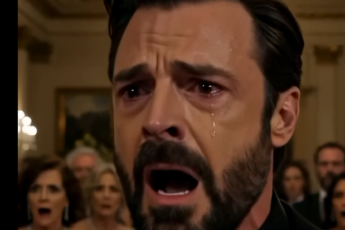
But now he bowed his head against the hand of the woman he had once promised to save, and grief returned like something that had only been waiting for the right door.
“I was too late,” he whispered.
Mirelle’s fingers moved weakly against his.
“Yes,” she said.
Then, after a pause:
“But not this time.”
She looked toward the boy.
That was her last gift to him.
Not forgiveness.
Direction.
She died before dawn.
Quietly.
With the river wind moving the curtain beside her bed.
The king sat beside her long after the physicians had stepped back and the candles had burned low. When at last he rose, he was no longer only a ruler confronting an old wound.
He was a father standing between a child and the machinery that had already tried once to erase him.
By sunrise, the lower city was under royal guard. Three men from the old palace watch were pulled from their homes before breakfast. One had fled before dawn and was found dead in the stables with his throat cut. Another broke under questioning by midday. The third remained silent until he saw the dagger laid before him.
Then he whispered the name no one in the palace had dared speak for years.
Lord Carrow.
The old king’s counselor. Believed dead six winters earlier. Buried with honor in the royal crypt.
Except Lord Carrow’s coffin, when opened that same afternoon in secret beneath the chapel, held not a body—
but stones.
He had never died.
He had vanished into the kingdom’s shadow with gold, loyal men, and the remains of the old king’s private network. And for years he had quietly kept certain truths from ever reaching the throne.
The prince’s lost lover.
The hidden child.
The knife left behind.
All of it had survived only because Mirelle had been stronger than the men sent to silence her.
For the next week, the king hunted like a man chasing his own shame through the dark. Carrow was finally found in a monastery cellar near the northern road, disguised as a dying scholar, his beard white, his hands still steady.
When brought before the king, he did not deny what he had done.
“Your father built stability,” he said. “I preserved it.”
“You preserved your power.”
Carrow almost smiled.
“There is no difference to old men.”
The king might once have answered with anger.
Instead he said only, “There is to sons.”
Carrow was executed before sunset, though no public proclamation ever explained why. Official records would call it treason. They would not mention Mirelle. They would not mention Leo. Some truths still frightened kingdoms more than swords did.
But not this king.
Three days after Carrow’s death, the king stood in the great hall again.
This time the throne room doors opened not to petitions, but to silence.
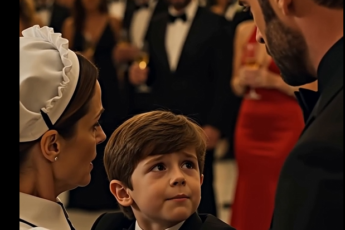
Leo walked in wearing simple dark clothes, still poor in cut but clean now, his small hand wrapped around the king’s fingers.
The court watched in astonishment.
The king did not sit on the throne.
He stood before it.
“This child,” he said, his voice carrying through stone and fear alike, “is my son.”
The hall did not erupt. Shock too deep rarely does.
It simply changed.
Men lowered their heads. Women stared. Old enemies began calculating new futures.
Leo looked up at the king, frightened but steady.
And the king, for the first time in many years, felt no need to hide tenderness from those who served him.
Mirelle was buried not in the lower city, but on the hill above the western gate where the evening light touched longest. No royal title was given to her in public. But the king placed her dagger beside her in the earth, and inside the tomb he ordered carved only one line:
She was told the crown had won. She lived long enough to prove it had not.
Years later, when Leo was old enough to ask whether his mother had hated the palace, the king answered honestly.
“No,” he said. “She hated what fear made men do inside it.”
And when Leo asked whether she had ever forgiven him, the king looked out the window toward the western hill and said:
“She trusted me with you. That was more than I deserved.”
It was not the kind of ending songs prefer.
There was no miraculous reunion in time. No life restored. No years returned.
But there was something rarer.
A truth buried by power that came back breathing.
And in the end, the dagger the king had once left behind on the worst night of his life did not become the symbol of betrayal he feared it was.
It became proof of something far more beautiful:
That even after love is hunted, lied about, and driven into hiding—
it can still return carrying a child by the hand.