No one entered Don Alessandro Vieri’s house without permission.
Not the men who guarded the iron gates with rifles beneath their coats.
Not the politicians who waited in black cars outside until summoned.
Not even his own sons, who knocked before crossing the threshold of the room where he ruled what remained of his empire from a velvet-lined wheelchair.
For twelve years, the old man had not stood on his own feet.
Once, Alessandro Vieri had been a legend in the underworld—a man whose name could silence a room faster than a gunshot. He had built his kingdom in the shadows of the city: gambling dens, shipping docks, judges in his pocket, enemies in unmarked graves. Age had silvered his beard and slowed his hands, but it had not softened him. Only one thing had ever truly defeated him—a bullet meant for his heart that shattered his spine instead. Since then, he had lived half a life in a chair of polished wood and black leather, his fury growing heavier each year.
That night, rain pressed against the tall windows of his villa like impatient fingers. The chandeliers glowed low. Smoke curled from the cigar resting between Alessandro’s knuckles. Around him, his most loyal men stood like statues in the amber dimness of the private hall.
Then the doors opened.
Not with a crash. Not with panic. They simply opened.
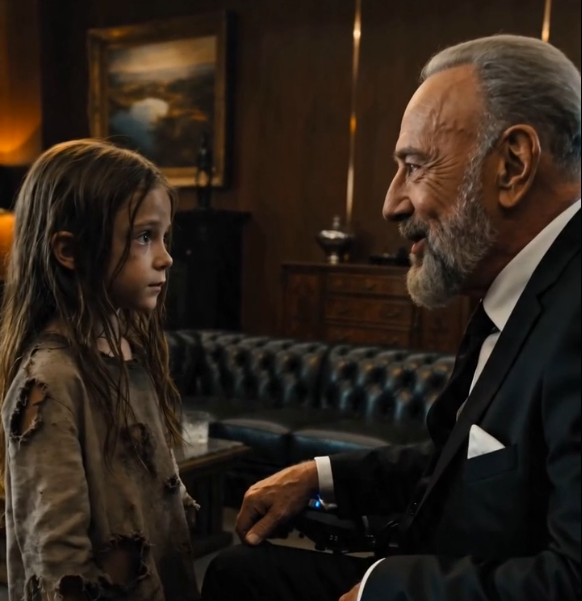
And into the room stepped a little girl.
She couldn’t have been more than eight. Her dress was torn and gray with street dust. Her shoes didn’t match. Dark dirt smudged her cheeks, and her hair fell in uneven strands around her face. She looked like a child the city had forgotten—one of those little ghosts who slept under stairwells and begged at traffic lights.
Every man in the room reached for a weapon.
But Alessandro lifted one finger, and they froze.
The girl walked forward without fear, past armed men, past marble columns, past the tiger-skin rug imported from another man’s ruin, until she stood directly before the old don.
Her eyes were strange. Not wild. Not frightened. Too calm.
“I can help you,” she said.
Alessandro stared at her, first amused, then curious. A thin smile tugged at the corner of his mouth.
“Who are you?” he asked. “How did you get in here?”
The girl did not answer. Instead, she stepped closer, so close that one of the guards inhaled sharply. Then she placed her small, grimy hand on the old man’s useless leg.
And she began to count.
“One…”
The nearest lamp flickered.
“Two…”
The crystal glasses on the table trembled, though no one touched them. The air in the room seemed to tighten, as if the walls themselves were holding their breath.
“Three.”
The chandeliers blazed and dimmed at once. A violent wind rushed through the sealed hall, lifting papers from the desk and making the flames in the fireplace bend sideways. Every man in the room staggered back. Alessandro felt something he had not felt in over a decade—pain.
Not the dull ache of old bones. Not the numb burning that mocked him every night.
Real pain. Sharp, electric, alive.
It shot from his hip to his ankle like lightning.
The cigar dropped from his hand.
His eyes widened. His fingers clenched the arms of the wheelchair.
“That’s impossible…” he whispered.
Then, with a groan that sounded almost like fear, Alessandro Vieri pushed himself upward.
For a moment the room stopped breathing with him.
The old man rose.
Unsteady, trembling, pale as stone—but standing.
His guards looked as if they were witnessing the dead return from the grave. One crossed himself. Another stepped backward, nearly dropping his pistol.
Alessandro’s chest rose and fell in jagged bursts. Tears—real tears—gathered in the eyes of a man whom no one had seen cry in forty years.
He looked down at the girl.
“What are you?” he asked.
This time she answered.
“I’m the one you forgot.”
Then she turned and walked toward the open doors.
Alessandro, who had made mayors kneel and killers disappear, followed her like a child follows a hymn.
No one dared stop him.
They moved through the sleeping villa, past portraits of dead ancestors, past guards who stared in horror as their crippled master crossed the halls on his own feet. The girl never hurried. She walked with quiet certainty, leading him not outside, as Alessandro expected, but down—down the hidden stairs behind the wine cellar, to the lowest part of the house.
There, buried beneath the marble and gold of his empire, was a locked iron room.
Only Alessandro knew what it contained.
His breath caught.
He had not opened that room in fifteen years.
The girl stood before the door and looked up at him. “Open it.”
His hands trembled as he entered the code.
Inside, the room smelled of dust, old paper, and regret.
It was smaller than he remembered. At the center stood a wooden chair. On one wall hung shelves of ledgers, documents, deeds, blackmail records—the bones of his empire. But it was not those that held Alessandro frozen in place.
It was the little pair of shoes on the floor.
Red shoes.
Child-sized.
Untouched by time.
His knees nearly gave out.
“No,” he whispered.
On the back wall was a framed photograph he had once hidden and never dared destroy. A young woman with kind eyes stood in a sunlit street, holding the hand of a little girl wearing those same red shoes.
The woman had been named Elena.
She had loved Alessandro before he became Don Vieri. Before the blood. Before the throne. Before fear turned into currency.
And the child—
He had been told the child died in a fire.
A fire started in a tenement building after Alessandro ordered his men to “send a message” to a traitor who had been hiding there. He had not known Elena and the girl were inside until it was too late. Or at least, that was the lie he had repeated often enough that it began to sound like truth.
He turned toward the little beggar girl.
She was standing beneath the dim bulb, her face still dirty, her dress still torn, but now he could see it—the shape of Elena’s mouth. Her eyes. His own brow.
“You…” His voice broke. “You’re my daughter.”
The girl shook her head gently.
“No,” she said. “I was your daughter.”
The room went cold.
Alessandro stepped back, his legs weakening for an entirely different reason now. “No…”
“You buried me here,” she said softly. “Not my body. Your memory of me. You locked me in this room with everything else you were afraid to face.”
Her voice was not angry. That was the worst part. It was tender.
“I came because tonight your men were going to kill your two sons.”
Alessandro looked up sharply.
“They made a deal,” she continued. “When you stood again, they would no longer need the old man in the chair. They are waiting upstairs. They think you’re still helpless.”
His face hardened. Instinct—old, lethal instinct—flashed through him. “I’ll kill them first.”
The girl looked at him with unbearable sadness.
“You still don’t understand.”
She reached to the shelf, took one of the thick ledgers, and placed it in his hands.
“Walk out of this house,” she said. “Go to the police. Tell them everything. Save your sons from becoming you.”
Outside, somewhere above them, thunder rolled across the sky.
Alessandro stared at the ledger. It contained names that could burn the city to the ground. Judges. Senators. Priests. His own blood.
He looked up to protest—to refuse, to bargain, to demand more time.
But the room was empty.
The girl was gone.
Only the faint sound of children laughing seemed to linger in the dust-heavy air.
By sunrise, the city awoke to impossible news.
Don Alessandro Vieri, the man no court had ever touched, walked into the central police station on his own feet carrying three ledgers and confessed to everything.
Before noon, raids had begun. His two sons were taken into protective custody. His captains vanished. Ministers resigned. Judges locked their doors. Empires fell by evening.
And by nightfall, Alessandro Vieri died quietly in a prison infirmary.
The doctors said it was his heart.
But the strangest detail emerged later, when investigators reviewed the security footage from the villa.
At exactly 11:57 p.m., the cameras showed the doors of the private hall opening by themselves.
No child entered.
No child left.
Only an old man in a wheelchair… and, several minutes later, the same old man walking out alone for the first time in twelve years.
In the pocket of the coat he wore that night, they found a small object no one could explain:
A single red shoe.