In the ancient kingdom of Ravaryn, people still spoke of King Aldric in two different voices.
The old soldiers spoke of the man he had once been—a lion on horseback, broad-shouldered and fearless, with a sword that seemed to flash like judgment itself. They remembered how he had ridden at the front of his armies with his crown under his helmet and victory already in his eyes.
But the younger people, those who had only known the palace from afar, spoke of a different king.
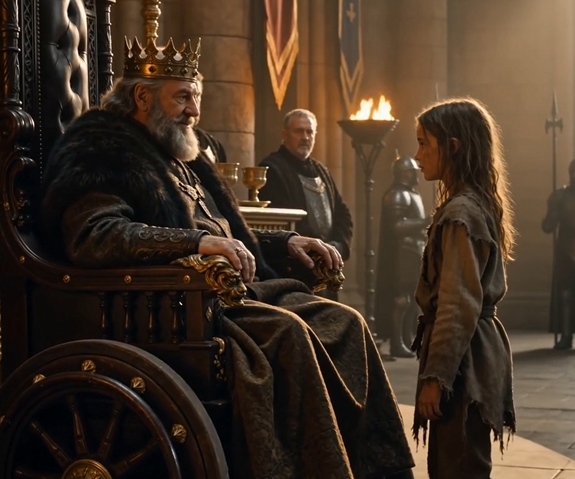
They knew King Aldric as the silent figure in the wheeled throne.
For twelve long years, he had not walked.
After a battle at Black Hollow, a spear had struck him low in the back and left his legs lifeless. Since then, he ruled from a magnificent ancient wheelchair crafted for kings of old—a throne on wheels made of carved dark oak, adorned with gold lions, leather cushions, and large wooden rims polished by the hands of servants. A velvet blanket always covered his motionless legs. Two attendants stood beside him wherever he went, and whenever the people saw him, they lowered their heads not only in respect, but in pity.
Yet pity was the one thing Aldric despised.
His pain had hardened him. The years in that chair had made him colder than winter stone. He taxed his people heavily, trusted no one, and filled his hall with fear instead of loyalty. The court still bowed to him, but love had long ago vanished from the kingdom like birds before a storm.
On the night everything changed, the great throne hall was full.
Torches burned in iron brackets along the walls. Crimson banners hung from the rafters. Snow pressed pale and silent against the stained-glass windows. Lords stood in their furs, ladies in their jewels, and guards with halberds lined the long aisle that led to the king’s throne.
King Aldric sat high before them, his crown gleaming above his silver hair, his gray beard resting against the fur at his collar. His hands, though older now, still looked strong enough to command a war.
A dispute over land was being read aloud when the great doors opened.
At first, no one noticed. The hall was too full of voices.
Then a draft slipped through the room, and heads began to turn.
A child had entered.
She was a small girl, no more than ten or eleven, dressed in torn, ragged clothes. Her feet were wrapped in strips of cloth instead of shoes. Her cheeks were smudged with dirt, and her tangled hair fell around her face like a shadow. She looked as though she had come from the poorest corners of the city—from the alleys where hunger slept and names were forgotten.
The guards moved at once.
But the strangest thing happened.
Though they stepped toward her, none of them reached her.
One guard later swore he felt his hands become suddenly heavy. Another said he forgot, for the span of a heartbeat, why he was moving at all. The child simply kept walking, slowly and calmly, as though the hall belonged to her more than it did to kings.
She stopped at the foot of the king’s wheeled throne.
The court fell silent.
Aldric stared down at her, annoyed at first, then curious.
The girl lifted her chin and said softly, “I can help you.”
A faint smile touched the king’s lips.
Around him, a few courtiers exchanged amused glances. Even in misery, there was something almost absurd in seeing a beggar child offer help to the most powerful man in the land.
Aldric leaned forward slightly in his ancient chair and studied her.
“Who are you?” he asked. “And how did you get in here?”
The girl did not answer.
Instead, she took one small step closer, raised her thin hand, and placed it gently on the velvet blanket over his lifeless leg.
The hall froze.
Then she began to count.
“One…”
A torch near the western wall flickered so violently that sparks fell to the floor.
“Two…”
The golden goblets on the king’s table trembled. A low hum passed through the air, deep and strange, as if the stones beneath the palace had begun to breathe.
“Three.”
The entire hall shuddered.
The torches bent sideways as though struck by invisible wind. The banners snapped. The chandeliers trembled. Somewhere high above, glass cracked.
And then King Aldric gasped.
For the first time in twelve years, he felt something below his waist.
Not pain. Not numbness.
Life.
It surged through his legs like fire poured into frozen branches. He gripped the lion-headed armrests of his wheeled throne so hard his knuckles blanched white.
His eyes widened.
“That’s impossible…” he whispered.
He pushed down on the armrests.
The attendants rushed forward in panic, but the king shoved them away.
Slowly—shaking, breathless, disbelieving—King Aldric rose.
A cry escaped the court. One noblewoman dropped to her knees. A priest crossed himself. Even the guards stepped back as though they had witnessed a dead man leave his grave.
The king was standing.
Unsteady, trembling, but standing.
Aldric looked down at the girl as though the world had split open before him.
“What are you?” he asked.
The girl’s expression did not change.
“I am not what you should ask,” she said quietly. “You should ask what you buried.”
Then she turned.
“Come with me, Your Majesty.”
The court expected him to call for guards, or question her further, or demand some explanation. But Aldric—his legs still shaking beneath him—did something no one expected.
He followed her.
The girl led him out of the great hall, through torchlit corridors and forgotten stairways no courtier had used in years. The king’s attendants trailed after him, pale and speechless, but when they tried to come too near, the girl glanced back once and they stopped, as if some ancient command had settled over them.
Down they went, deeper into the old palace.
At last they reached a sealed wooden door hidden behind a tapestry in the abandoned west wing.
Aldric stopped.
He knew that door.
It had once belonged to Queen Seraphine.
His breath caught in his throat.
No one had entered her chambers since the night she died.
The girl looked at him.
“Open it.”
His hands trembled as he pushed the door.
It opened with a long, aching groan.
Dust floated in silver lines through the moonlight. The chamber smelled of cedar, lavender, and time. A cradle stood in one corner, draped in a moth-eaten veil. A faded tapestry of stars hung behind it. On the table lay a queen’s comb, a silver mirror, and a tiny pair of knitted infant slippers, untouched for over a decade.
Aldric staggered inside.
He had not allowed himself to think of Seraphine in years. She had died giving birth to their first child, a daughter. The infant, he had been told, was too weak to survive and died before dawn. In his grief, he had sealed the chambers and never returned.
Yet the girl walked straight to the cradle and reached beneath it.
From the shadows she drew out a small wooden box.
“How did you—” Aldric began.
“Because this room remembers,” she said.
Inside the box was a bundle of letters wrapped in blue ribbon.
The king opened the first with shaking fingers.
It was written in the hand of Lord Maelor, his late chancellor.
A confession.
Aldric’s vision blurred as he read.
The child had not died.
Maelor had feared a prophecy spoken over the newborn princess: The daughter born beneath a bleeding moon will end the reign of iron and return the crown to mercy. Believing the prophecy dangerous, he had ordered the infant taken from the palace and abandoned in the lower city. He had lied to the grieving king. Years later, it was Maelor’s son who arranged the ambush at Black Hollow, ensuring that Aldric survived—but never walked again—so the throne could be controlled by weak kings and clever men.
Aldric felt the room spin.
“No…” he breathed. “No…”
He looked at the girl.
Her face, still dirty and thin, seemed suddenly transformed by the moonlight. In her eyes he saw something that made his heart stop.
Seraphine.
The same deep, clear eyes the queen had worn when she smiled.
The same small mark near the brow.
“You…” His voice broke. “You are my daughter.”
The girl held his gaze for a long moment.
Then, very softly, she said, “I was.”
The world went silent.
Aldric stared at her, unable to breathe.
“What do you mean?”
She looked toward the cradle.
“They left me where the river road meets the city gate,” she said. “A woman who begged for bread found me and kept me alive for three days. On the fourth night, winter took me.”
The king’s knees nearly buckled.
“No…”
“But the kingdom remembered,” the girl continued, calm as moonlight. “And so did my mother.”
Tears rushed into Aldric’s eyes, hot and sudden.
“I did not know,” he whispered. “I swear to you, I did not know.”
“I know,” she said.
There was no anger in her voice. That was what shattered him.
Only sadness.
“Then why have you come?” he asked.
She stepped closer.
“To help you stand,” she said. “Not only on your feet. In truth.”
At dawn, the bells of Ravaryn rang unlike they ever had before.
King Aldric entered the great hall walking on his own legs.
Before the full court, he read Maelor’s confession aloud. He named every man who had hidden the truth, every lord who had profited from his weakness, every hand that had turned the kingdom cruel. He ordered arrests. He opened the grain stores. He canceled the winter tax. Then, before nobles and servants and soldiers, he laid his crown upon the steps of the throne and said, “A king who rules without mercy is no king at all.”
The court watched in astonishment.
When he finished, he turned to summon the girl—to name her princess before all the kingdom, to fall at her feet if he had to, to beg forgiveness before every eye in the hall.
But she was gone.
No one had seen her leave.
The guards at the doors swore no child had passed them.
The servants searched the palace until evening and found nothing.
At last, near sunset, Aldric returned alone to Seraphine’s chamber.
There, beside the cradle, he noticed something he had missed before.
A tiny stone slab had been set into the wall behind the curtains, hidden by shadow and age. He knelt before it and brushed away the dust.
Carved into the stone were the words:
Princess Elira
Born of the Crown
Beloved for Four Days
The king stared at the inscription, his breath breaking in his chest.
At the base of the stone lay one thing that had not been there before:
A small silver ribbon, tied around a child’s bracelet.
It was the same bracelet Queen Seraphine had clasped around their daughter’s wrist the night she was born.
Aldric lowered his head and wept.
Outside, through the narrow window, the last light of evening spread across Ravaryn like gold poured over stone. And for the first time in many years, the kingdom felt lighter—as though some ancient sorrow had finally been named.
King Aldric ruled only one more year.
In that time, he became the kind of king his people had once prayed for. He walked among them without guards. He rebuilt the poor districts. He fed the hungry. He listened before he judged. And every winter, on the night when the snow first touched the palace windows, he left the great hall empty and lit a single candle in the queen’s abandoned chamber.
When he died, the people did not remember him as the crippled king in the wheeled throne.
They remembered him as the king who stood at three—
because a little beggar girl had returned from beyond death to teach him how.