For years, the king never allowed anyone to speak the child’s name.
Not in the palace.
Not in the court.
Not even in prayer.
His only son had vanished when he was still a baby, and whatever hope had once lived in the king’s heart had long ago hardened into silence. Some said the child had died. Others whispered he had been kidnapped by enemies of the crown. A few believed something darker—that the boy had been taken by someone inside the palace itself.
No one knew the truth.
Or rather… no one dared to ask.
The queen had died not long after the child disappeared, and from that day on, the king became a colder man. He ruled well, but without softness. He trusted fewer people each year. His court remained grand, his kingdom rich, his enemies afraid—but the warmth that once made people love him had vanished with the child.
Only one thing remained from those lost days.
A small pendant.
It had been made by the queen herself, a delicate piece of gold shaped like a sunburst, with a tiny blue stone in its center. She used to say it would protect their son wherever he went. It had vanished with him on the night he disappeared.
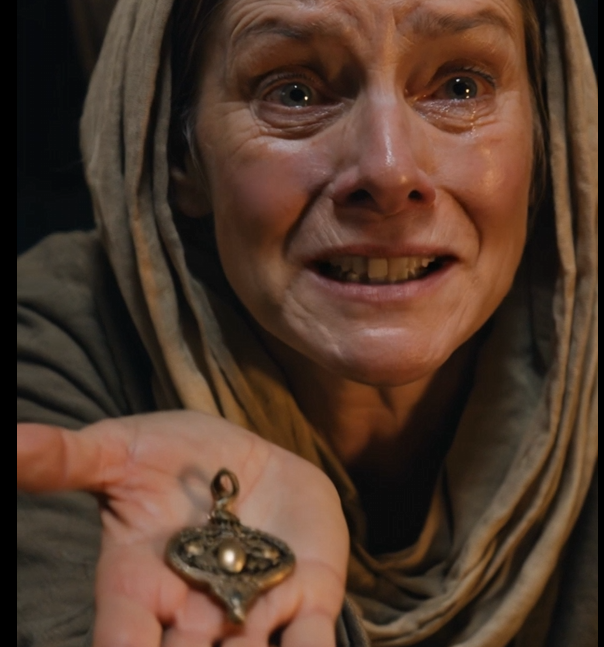
That was why, when the old woman entered the hall with it clutched in her trembling hand, the room seemed to stop breathing.
It happened on an ordinary court morning.
Nobles stood in their places. Guards lined the walls. Petitioners waited for permission to speak. The king sat upon the throne with the distant, stern look everyone in the palace had come to know.
Then the doors opened.
At first, no one paid attention. Another peasant, perhaps. Another complaint about crops or taxes.
But when the guards brought her forward, something was different.
She was old—bent with age, wrapped in worn clothes, her face marked by hardship. Yet she did not look frightened in the way commoners usually did in front of the throne. She looked desperate.
And desperate people were dangerous.
“My king,” she cried, falling to her knees.
“I found your son.”
The court erupted in murmurs.
The king stood so abruptly that even the guards near him flinched.
“My son died years ago,” he said sharply.
The old woman shook her head, tears running down her weathered face.
“Then why,” she whispered, opening her hand, “was this hanging from the boy’s neck?”
The pendant caught the torchlight.
Gold. Sunburst. Blue stone.
The king went pale.
For a moment, he could not speak.
Everyone in the hall felt it—the shift, the sudden crack in the stone-cold certainty that had ruled the palace for years.
He descended from the throne slowly, never taking his eyes off the pendant.
“Where did you get this?” he asked.
The old woman swallowed.
“There is a boy,” she said. “He lives in the lower quarter, near the abandoned mills. I have fed him for years. He is poor, but quiet. He never knew where he came from. He always wore this. I asked him once where he got it, and he told me it had always been around his neck.”
The king’s hand trembled as he reached for the pendant.
It was the real one.
He knew it from the tiny imperfection near the clasp, where the queen had once dropped it before the child was born.
No imitation could have carried that mark.
“Bring him,” the king said.
No one moved.
His voice rose like thunder.
“Bring him to me. Now.”
By sunset, the boy stood in the throne hall.
He was perhaps ten years old. Thin. Dusty. Guarded in the way poor children often were, as if life had taught him too early that kindness rarely lasted. His clothes were simple, patched many times. His eyes—dark and cautious—moved across the hall like those of a trapped animal.
But when he looked at the king, something strange happened.
The king’s breath caught.
There was something in the boy’s face.
Not enough for certainty.
But enough for pain.
The old woman had not lied. The pendant had indeed hung around his neck. The boy did not deny it.
“What is your name?” the king asked.
The child hesitated.
“Tom,” he said quietly.
“That is not your real name,” the king replied.
“It is the only one I know.”
The hall remained silent.
The king stepped closer.
“Who raised you?”
The boy looked down.
“No one. Not really. I stayed with whoever would let me work. Sometimes the old woman fed me. Sometimes I slept by the mill. Sometimes in the market.”
The king’s face tightened.
“And you know nothing about this pendant?”
The boy shook his head.
“I’ve always had it.”
Something in the king’s chest twisted.
He turned to his advisers, to the captain of the guard, to the old servants who had been in the palace since before the disappearance. One by one, they examined the boy. The age matched. The pendant matched. And there was more.
A scar behind his left ear.
The prince had fallen as an infant once, striking the cradle’s carved edge. It had left a tiny crescent-shaped mark.
This boy had the same scar.
The court began to believe.
Whispers rose.
“The prince…”
“It must be him…”
“After all these years…”
The king dismissed the court early. The boy was taken to private chambers, bathed, fed, dressed in fine clothes. The best physicians examined him. The oldest nurse in the palace, now half-blind and long retired, was brought in. She touched the boy’s face with trembling fingers and began to cry.
“It is him,” she whispered. “Or else God himself has made another just like him.”
The king said nothing.
But that night, for the first time in years, he wept.
In the days that followed, the palace changed.
The king softened. The corridors seemed warmer. Servants smiled when they passed one another. Nobles who had long forgotten how hope felt began speaking of the future again. The people in the city heard the news and lit candles in the streets.
The lost prince had returned.
It felt like a miracle.
But miracles are often fragile things.
The boy did not behave like a prince.
He ate cautiously, as though he expected the food to be taken away. He flinched at loud voices. He did not trust silk sheets or warm fires. He thanked servants for crumbs as if they were gifts from heaven. At night, he woke from sleep with fear in his eyes and clutched the pendant in his hand.
The king tried to be patient.
He told himself these were the wounds of a hard life.
He walked with the boy in the gardens. He showed him the old nursery. He told him stories of the queen—how she laughed, how she sang, how she used to hold him. Sometimes the boy listened quietly. Sometimes he seemed far away.
And yet, little by little, something grew between them.
Not recognition.
Not yet.
But tenderness.
The king began to believe that perhaps love could be rebuilt even when memory could not.
Then one evening, everything changed.
It was late. Rain tapped softly against the windows. The king had dismissed the servants and sat alone with the boy in a private chamber, the pendant resting on the table between them.
For a while, neither spoke.
Then the boy lifted his eyes and asked:
“Why did you stop looking for me?”
The question struck harder than any accusation.
The king stared at him.
“I never stopped.”
The boy’s face remained unreadable.
“They told me you did.”
“Who told you that?”
The boy looked at the pendant.
“My mother.”
The air in the room turned cold.
The king’s throat tightened.
“Your mother is dead,” he said, too quickly.
The boy looked back at him.
“No,” he said softly. “She isn’t.”
The king rose to his feet.
“That’s impossible.”
The boy reached into his tunic and pulled out something small—something he had hidden there even after being bathed and dressed.
A folded strip of cloth.
He placed it beside the pendant.
The king unfolded it with unsteady fingers.
Inside, stitched in faded thread, were words.
If he returns you to the palace, do not trust the man on the throne.
The king went white.
He knew the stitching.
It was the queen’s.
Not the formal hand she used for decrees or letters—but the private embroidery she used for small things. He remembered watching her sew by candlelight, teasing her for how serious she looked with a needle in hand.
This was hers.
His knees nearly failed him.
The boy spoke again, quietly, almost kindly.
“She didn’t die,” he said. “She lived. She hid. And before she died for real… she told me to come back only when I was old enough to understand.”
The king’s voice broke.
“Understand what?”
The boy held his gaze.
“That I was never taken by enemies.”
Silence.
The rain against the windows seemed suddenly louder.
The king did not breathe.
The boy’s eyes filled—not with fear, but with the sadness of someone forced to grow too quickly.
“She told me,” he whispered, “that the night I disappeared… someone inside the palace opened the gate.”
The king closed his eyes.
Because now, at last, he knew which truth had returned with the child.
Not just the prince.
The past.
And the past had teeth.
“I did not order it,” the king said.
The boy said nothing.
“I did not know,” the king added, but even to his own ears the words sounded thin.
The child looked down at the pendant.
“She used to say you would say that.”
The king sank slowly into his chair.
The room spun around him.
Because he had known something, years ago. Not the whole truth. Not the final betrayal. But enough to be guilty.
He had known there were whispers against the queen. He had known powerful men in his council feared the influence she had over him. He had known that one of them, Lord Maren, had urged him to send her away for a few weeks “for the child’s safety” during unrest in the capital.
And he had agreed.
Only for a little while, he had thought.
Only until danger passed.
He had trusted the wrong man.
Before dawn, the child had vanished. The queen never returned. Lord Maren had come to him in tears, claiming bandits attacked the escort. No bodies were found. The king searched, yes—but not long enough, not hard enough, because part of him had believed the lie that grief often chooses when truth is too painful to bear.
It was easier to think them dead.
Easier than admitting betrayal had happened beside his own throne.
And now that cowardice stood before him in the shape of a child wearing a pendant.
“Where is Maren?” the king asked at last.
The boy did not answer.
He did not need to.
Because at that very moment, from somewhere deep in the palace, a bell began to ring.
Once.
Twice.
Then again and again.
Alarm.
The king and the boy looked up together.
The chamber doors burst open. A guard stumbled in, face pale.
“Your Majesty—Lord Maren is dead.”
The king stood.
“How?”
The guard swallowed.
“In his rooms. No sign of struggle. Only…” He hesitated.
“Only what?”
The guard looked at the boy.
“Only the queen’s seal. Left on his chest.”
By midnight, the palace was in chaos.
Maren was dead indeed—cold, unmoving, with the queen’s old silver seal pressed into his robe like a judgment from the grave. No one could explain how anyone entered his guarded chambers. No servant had seen a thing.
The king’s councillors whispered of ghosts.
The guards whispered of revenge.
But the king knew better.
This was not a ghost.
This was a reckoning.
He turned back toward the boy’s chamber—
and found it empty.
The window stood open.
Rain drifted in.
The pendant lay on the table.
The boy was gone.
This time, not stolen.
Gone by choice.
The king rushed to the window and looked into the storm-dark courtyard below, but there was nothing there except shadows and rain.
Only then did he notice one final thing beneath the pendant:
another scrap of cloth.
He opened it.
This time, the message was short.
You were not the man she feared most.
That is why I came back for you… before I leave for him.
The king read it once.
Then again.
And for the first time in years, a different truth reached him.
The boy had not returned to reclaim a crown.
He had returned to give his father one final chance to face what he had failed to face before.
And then he had left—not as a lost prince, but as the queen’s son.
A son who had come home only long enough to separate guilt from evil.
The king stood alone in the rain-cooled chamber, the pendant in his hand, and understood the cruel beauty of it.
He had spent years believing he lost his child forever.
But the real tragedy was stranger than loss.
His son had found him.
Forgiven him.
And still chosen not to stay.