The princess had learned to cry without making a sound.
It was a skill no royal child should ever need, but palaces teach strange lessons to those born inside them. She had learned how to smile at people she did not trust, how to bow to men who had already decided her future, and how to sit still while others spoke about her life as if it were a treaty to be signed.
By the age of nineteen, she was admired across the kingdom for her beauty, her grace, and her obedience.
No one knew that obedience had been the hardest mask of all.
Because for years, her heart had belonged to someone the palace would never accept.
Not a prince.
Not a noble.
Not even a knight.
He was the son of a poor carpenter who lived near the southern wall of the capital, where the streets narrowed and the houses leaned into one another as if trying to survive the wind together. He had grown up with rough hands, a quiet smile, and eyes too honest for court life.
His name was Adrian.
They met when the princess was sixteen.
Not during a feast or ceremony, but by accident.
She had slipped out of the palace gardens disguised in a servant’s cloak, desperate for one hour of life that did not belong to the crown. Near the market square, her horse was startled by a passing cart, and before she could steady herself, she fell hard against the stones.
The crowd had backed away in fear, not because they recognized her, but because poor people learn early not to involve themselves in trouble they cannot afford.
Only one person ran toward her.
A young man.
Dust on his sleeves. Sawdust caught in his hair. Hands strong enough to lift her as though she weighed nothing.
“Are you hurt?” he had asked.
She should have lied. She should have left. She should have returned to the palace and forgotten his face.
Instead, she looked at him and said, “No.”
It was the first lie she ever told him.
After that, she found reasons to leave the palace more often.
Sometimes disguised. Sometimes hidden behind excuses. Sometimes only for a few moments near the old chapel ruins outside the city, where no nobles rode and no servants watched.
She learned the sound of his footsteps before she saw him. He learned the way her voice changed when she was not pretending to be royal.
For the first time in her life, someone loved her without wanting anything from her name.
He did not flatter her.
He did not fear her.
He did not dream of her as a crown.
He loved her as a girl.
And she loved him with the kind of certainty that only comes once—when the heart has not yet been taught to negotiate with power.
For two years, they kept their secret alive.
They met at dusk, in rain, in early morning fog. He carved her small birds from wood because she once told him she envied creatures born without walls. She gave him a silver thread from one of her dresses, tied around his wrist beneath his sleeve where no one could see it.
He used to tell her they would leave one day.
Not yet. Not while they were young and watched too closely. But someday.
She wanted to believe him.
And she did.
Until the king announced her marriage.
It happened without warning, though in truth such things rarely arrive without signs—only daughters born in palaces are raised not to read them.
A foreign alliance had become necessary. War threatened along the eastern border. A prince from a neighboring kingdom had offered peace through marriage, and the king, old and weary and haunted by the burdens of rule, accepted before even speaking to his daughter.
She was informed, not asked.
The wedding would take place in three days.
The court rejoiced. Diplomats smiled. The kingdom praised the wisdom of the crown.
The princess stopped breathing somewhere inside herself and did not fully recover.
That night, she sent word to Adrian.
Not openly. Not through a servant she trusted—because there were none.
Only a torn scrap of linen tied to the old branch near the chapel ruins, the sign they had once agreed meant danger.
He did not come that night.
Nor the next.
By the third evening, the palace had become a prison dressed in silk.
Seamstresses entered and left her chambers like ghosts, fitting her wedding gown. Ladies of the court spoke softly about jewels and processions. Priests came to bless the bridal room. Guards stood more thickly in the corridors than before.
The princess had nearly begun to believe he would not come.
That perhaps he had understood and chosen survival over love.
And then—
Near midnight, when the palace had gone quiet except for the low breathing of guards beyond the doors and the whisper of wind against the high windows, a shadow moved near the hidden side entrance behind the tapestry.
The princess turned.
And there he was.
Adrian.
Breathless. Pale from climbing stone and darkness. His cloak damp from the night air, his chest rising and falling as if he had outrun half the kingdom to stand before her.
For one brief, impossible second, joy struck her harder than fear.
He crossed the room quickly.
“I came, my love,” he said, his voice low and shaking with urgency. “We can run away from here.”
She stared at him.
This was the moment she had dreamed of so many times that she should have known what to do.
Run to him. Take his hand. Leave everything behind.
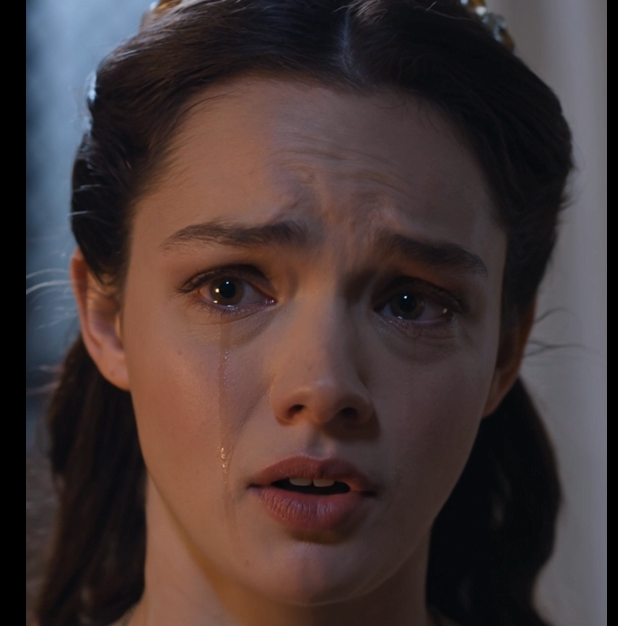
Instead, tears filled her eyes before words did.
Because reality had already moved one step ahead of love.
“I’m sorry,” she whispered.
He froze.
“You’re too late.”
The room seemed to shrink around them.
“What do you mean?”
She shook her head, crying now.
“I marry tomorrow.”
For a moment, he did not understand.
Or perhaps he understood too well and simply refused it.
“No,” he said. “No, then we leave tonight. Right now. There’s still time.”
She wanted to say yes.
God, she wanted to say yes.
But even as he spoke, she heard it—
the faint metallic sound beyond the chamber walls.
Armor.
Movement.
Too controlled to be accidental.
Her face changed, and Adrian saw it instantly.
“What is it?” he whispered.
The princess stepped toward him.
Then stopped.
Because she knew.
Knew with the sick certainty of someone raised among schemes that something was wrong. Too wrong.
She had not sent for him this time.
Not truly.
She had left the sign, yes. Days ago. But only one person had seen her near the old chapel ruins when she tied the cloth there.
Her father’s chamberlain.
A quiet man with clever hands and no soul she could ever find in his eyes.
The realization broke through her too late.
“It was a trap,” she breathed.
Adrian’s face drained of color.
At that exact moment, the chamber doors burst open.
Royal guards flooded the room.
No shouted commands. No hesitation. Just steel, speed, and certainty.
They had come not to discover him.
They had come for him.
Adrian turned instinctively, reaching for the dagger at his side, but there were too many. They seized his arms before he could draw it. One struck him in the ribs with the butt of a spear. Another forced him to his knees.
The princess screamed.
Not loudly.
Worse than that.
The sound of someone breaking where no one can see.
She rushed toward him, but a guard blocked her path with one armored arm.
“No!” she cried. “Don’t hurt him!”
Adrian looked up at her through pain and shock.
And in his eyes, she saw the truth settle.
This had never been about stopping a scandal.
It had been about removing him.
The captain of the guard stepped into the room last.
He did not kneel to the princess.
He did not apologize.
That frightened her more than the armor did.
“His Majesty requests that you prepare for tomorrow’s ceremony,” he said.
The words were polite.
The meaning was murder.
The princess went cold.
“Where are you taking him?”
The captain’s face remained blank.
“That is not for Your Highness to know.”
Adrian struggled once, uselessly. A guard drove him down harder.
The princess’s whole body shook.
“Please,” she whispered. “Please…”
The captain looked at her then, and for the first time there was something like pity in his face.
But not enough to matter.
When they dragged Adrian toward the door, the princess broke past the nearest guard and fell to her knees in front of him. Her hands found his face, bruised already, breathless, alive.
“I’m sorry,” she cried. “I’m so sorry.”
He leaned into her touch as much as the guards allowed.
And even then, even there, with death standing in armor all around him, he gave her the same thing he always had.
Not fear.
Not blame.
Love.
“It’s not your fault,” he said.
They tore him from her.
The doors slammed shut.
And the princess remained on the stone floor, one hand outstretched toward emptiness, while the candles trembled in the draft left behind.
By dawn, the palace had transformed itself into celebration.
Musicians arrived. White roses were carried into the chapel. Gold-threaded banners were hung from the eastern balconies. The foreign prince’s escort rode through the gates under a sky so beautiful it felt cruel.
The princess did not sleep.
She did not eat.
She did not speak except once—to ask where Adrian had been taken.
No one answered.
At midday, her father came to her chambers.
The king looked older than usual. Not guilty. Not proud. Simply tired in the way rulers often are when they have convinced themselves that cruelty is another form of necessity.
“You will marry tomorrow,” he said.
She stared at him.
“What did you do to him?”
The king was silent.
That was answer enough.
Something changed in her then.
Up until that moment, she had still been a daughter begging her father to remember she was human.
Now she stood.
And became something else.
“If he dies,” she said quietly, “you lose me too.”
The king looked at her for a long time.
But he was a man who had ruled too long to hear warnings unless they came from armies.
“You are overwrought,” he said.
Then he left.
The wedding preparations continued.
That evening, when the sun had almost gone and the palace glowed with the last warm light before darkness, the princess did something no one expected.
She asked to pray alone in the royal chapel before the wedding.
The request was ordinary enough to be allowed.
Two guards walked her there, waited outside, and believed themselves safe.
Inside the chapel, hidden beneath the altar steps where royal brides once left offerings before marriage, there was an old passage no one used anymore.
As a child, she had found it during games with her brothers. As a young woman, she had told Adrian about it once, laughing, never imagining it might one day matter.
Now it mattered.
Because beneath the altar, wrapped in old cloth and dust, she found what she had hidden there months ago.
A plain servant’s cloak. A small knife. And a key.
Not to freedom.
To the lower cells.
She had taken the key from the chamberlain long before she understood why she might need it. Something in his manner had always frightened her. Palaces teach daughters suspicion even when they pretend to teach only grace.
Within minutes, she was beneath the palace.
No jewels. No silk veil. No bridal white.
Only darkness, cold stone, and the sound of her own heart.
She found Adrian in the last cell.
Bruised. Chained. Alive.
For one second, neither moved.
Then he laughed softly—a broken, disbelieving sound.
“You always were better at escaping than I was.”
She opened the cell with shaking hands.
“There’s no time.”
He stepped forward, weak but standing.
“Come with me,” he said.
And there, in the darkness beneath the palace, she faced the choice that had been growing toward her since the day they met.
Love.
Or the crown.
But this time the choice was no longer the one her father believed in.
Because she had realized something while walking through halls prepared for her wedding:
A crown that must be protected by killing love is already broken.
So she took his hand.
And together they ran.
The palace erupted by dawn.
The princess was gone. The prisoner was gone. The wedding chapel stood full of nobles, priests, and foreign envoys waiting for a bride who would never arrive.
The king sent riders in every direction.
Roads were sealed. Bridges watched. Villages searched.
But no one found them.
Weeks passed.
Then months.
At first the kingdom whispered of scandal. Of shame. Of madness.
But stories change when they survive long enough.
In time, another version began to spread.
That the princess had not been stolen.
She had chosen.
That the poor young man had not corrupted her.
He had only reminded her what freedom looked like.
Years later, travelers in the western hills spoke of a woman with royal bearing and a man with carpenter’s hands living near a lake where no banners flew. Some said they had children. Others said the woman planted white roses beside the water each spring and smiled whenever the wind moved across them.
No one ever proved it.
The king never saw his daughter again.
But every year, on the day the wedding had been meant to happen, a single wooden rose appeared on the chapel altar.
Hand-carved.
Perfectly shaped.
Left where no guard ever saw anyone enter.
And that was the most beautiful punishment of all.
Because the king had won peace for his kingdom—
but lost the only daughter who might have loved him enough to forgive the price.