For three years, the kingdom had lived with a wound it had never truly closed.
The prince was dead.
That was the official truth. That was the truth written into the royal records, spoken in prayer, mourned in black cloth and lowered flags. The prince, the king’s only son, had fallen in battle at the northern frontier while leading men twice his age into a war he should never have had to fight.
The body was never returned.
Only his horse came back.
Bloodied. Riderless. Half-mad with fear.
Then the royal banner was found torn in the mud near the river crossing, and the men who survived swore they had seen the prince surrounded by enemy soldiers before the fog swallowed everything.
It was enough.
Enough for the court to mourn.
Enough for the priests to bless an empty tomb.
Enough for the king to bury his son without a body.
But not enough for him to believe it.
Not fully.
Not in the hours before dawn, when he would wake with the cold certainty that somewhere beyond the borders of his kingdom, his son was still breathing beneath a sky that did not know his name.
The king never spoke of that feeling.
Kings were not supposed to be ruled by instincts they could not prove.
So he wore grief like armor. Silent. Heavy. Permanent.
The court adjusted around it. The laughter in the palace grew quieter. Music in the great hall became rarer. The old warmth that had once softened the king’s face vanished, replaced by a hardness people called wisdom only because they were too afraid to call it sorrow.
Then, on a gray morning wrapped in mist, a rider came through the eastern gate.
At first, the guards barely recognized him.
His armor was cracked and dusty. His cloak was torn nearly to ribbons. Blood—old and dried—darkened one side of his shoulder. The horse beneath him trembled with exhaustion. The man himself looked more ghost than knight.
But when he dismounted and fell to one knee in the royal courtyard, clutching a torn royal banner in his hands, the palace stopped around him.
“Your Majesty…” he said, fighting for breath.
“The prince is alive.”
The words spread faster than fire.
Servants stopped moving. Guards turned. Nobles came from shadowed corridors like people drawn unwillingly toward a storm.
And when the king appeared at the top of the stone steps, wrapped in fur and silence, the courtyard seemed to shrink under the weight of his gaze.
“My son died in battle,” he said.
The knight looked up.
This was Sir Aldren—one of the men who had ridden beside the prince on the northern campaign. Loyal. Quiet. Never known for dramatics, which made his presence more dangerous than any loud accusation could have.
“Then why,” Aldren asked, raising the torn banner with trembling hands, “did he give me this… before they took him?”
The king descended the steps himself.
He did not wait for servants. He did not send for counselors.
He took the banner from the knight’s hands.
At once he knew it was real.
The prince’s own battle standard—marked with the silver hawk of the royal line, though now split by a blade and stained dark where someone’s blood had soaked deep into the fabric.
The king gripped it so tightly his knuckles paled.
“Tell me everything,” he said.
The hall was cleared within minutes.
Only the king, Aldren, two captains of the guard, and the old chancellor remained. A fire burned low in the chamber, though no one seemed to feel its warmth.
Aldren stood in the center of the room and began.
The northern battle had gone badly from the start. The enemy had known too much—where the prince would ride, where the reserve forces would break, where the river crossing could be trapped. Someone had either betrayed them… or the enemy had a mind inside their camp.
Still, the prince fought.
Not recklessly. Not foolishly. Like a man raised to command and determined to earn it.
“He should have turned back,” Aldren said. “Any other man would have.”
“But he wasn’t any other man,” the king answered.
Aldren lowered his eyes.
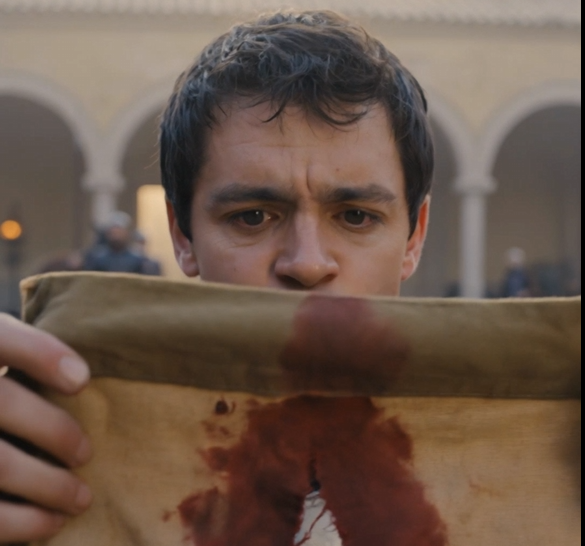
“No.”
When the line broke, the prince gathered what men he could and rode for the eastern ridge, trying to buy time for the others to retreat. It nearly worked. But enemy cavalry came down through the fog, cutting them off.
Aldren had been thrown from his horse. When he rose again, bleeding and half-blind, he saw the prince still fighting—surrounded, but alive.
“I tried to reach him,” Aldren said. “I swear it.”
The king said nothing.
“The last time I saw him,” Aldren continued, “he was standing. His sword was broken, but he was standing.”
Then the prince had seen Aldren.
And done something strange.
He tore the banner from its pole, wrapped part of it around his arm, and threw the rest toward him.
“Take it,” he had shouted.
Aldren’s voice broke slightly at the memory.
“I thought he wanted the banner saved.”
The king’s jaw tightened.
“And now?”
Aldren looked up.
“Now I think he wanted to send a message.”
There was silence.
“What message?” the old chancellor asked.
Aldren hesitated.
Then he stepped forward and pointed to the inner seam of the banner.
“At first, I thought it was only torn,” he said. “But when I hid in the marshlands two nights later and tried to bind my wound with it… I found something sewn inside.”
He reached into his tunic and removed a narrow strip of cloth.
Folded.
Small.
The king took it.
The stitching was rough, hurried, but unmistakably done by someone with a blade tip and shaking hands.
Inside were six words:
Do not trust the men behind you.
The room went cold.
The king read the line twice.
Then once more.
Not the men before you.
Not the enemy.
The men behind you.
The old chancellor crossed himself without thinking.
The captain of the guard shifted his weight uneasily.
Aldren continued.
He had not come back immediately because the northern roads were watched. Twice he was nearly killed. Once he was captured and escaped. He had kept the cloth hidden in the lining of his armor until he could ride safely south.
“And why come now?” the king asked.
“Because I wasn’t followed before,” Aldren said. “This time, I was.”
The king’s eyes lifted slowly.
“By whom?”
Aldren’s face tightened.
“I don’t know.”
That answer was not enough. Not in a royal chamber where fear already moved like a living thing.
The king dismissed everyone but Aldren.
For a long moment they stood alone, separated by rank and grief and the terrible intimacy of shared hope.
Then the king asked the question he had feared most.
“When you saw him… did he look afraid?”
Aldren swallowed.
“No.”
The answer hurt more than if he had said yes.
Because fear would have made him only a son.
Courage made him the prince.
That night, the king did not sleep.
He sat alone with the torn banner across his knees and the stitched message open beside him. Hour by hour, names moved through his mind.
The men behind him.
Which men?
His captains?
His council?
His oldest friends?
The nobles who had urged war?
The generals who praised the prince too loudly in public and envied him too deeply in private?
Or was it something closer still?
By dawn, he had decided only one thing:
If his son lived, then someone in the kingdom needed him dead badly enough to lie to a king’s face and bury a prince without proof.
That meant the danger had never left the palace.
It had only become comfortable there.
The search began in secret.
Publicly, nothing changed. Court went on. Decrees were signed. Bells rang. Envoys were received.
Privately, the king replaced half the night guard with men loyal only to him. He sent riders north under false banners. He ordered records reopened—battle maps, dispatches, casualty rolls, even the names of servants who had handled messages during the campaign.
Within days, irregularities appeared.
Orders delayed without explanation. Supply lines rerouted at the last moment. One messenger dead in a roadside ditch. Another vanished entirely. A third listed in palace records as having delivered a sealed command on the eve of battle… though no one could now say who wrote it.
The king followed the trail himself, piece by piece, until it led somewhere he had never expected.
Not to a general.
Not to a foreign spy.
Not even to a rival noble house.
It led to the chancellor.
Old Chancellor Merrow, who had served the crown since the king’s father wore it. Merrow, whose hands shook from age and whose voice never rose. Merrow, who had stood quietly in the chamber when the stitched warning was first read.
The king refused to believe it at first.
Merrow had helped raise the prince.
He had taught him letters.
He had stood beside the queen during her illness.
He had been woven into the royal family so long that distrusting him felt like distrusting memory itself.
But memory, the king was learning, was a poor guard against truth.
When Merrow’s private scribe was taken and questioned, the old man broke within an hour.
He confessed to altering dispatches.
To delaying reinforcements.
To ensuring the prince rode into a trap.
But not for gold.
Not for foreign loyalty.
For something worse.
For peace.
He said the prince was too loved by the army. Too admired by the people. Too young, too bold, too likely to become the kind of ruler who would drag the kingdom into endless wars for glory.
The king, by contrast, had grown tired. Careful. Predictable.
“The kingdom needed stability,” the scribe said through tears. “The chancellor said the prince would burn it alive.”
When the king heard this, he said nothing for a long time.
Then he asked the only question that mattered.
“Where is my son?”
The scribe shook his head.
“I don’t know. The prince was never meant to survive the ridge.”
But he had survived.
That much was now certain.
Which meant the story did not end with betrayal.
It continued beyond it.
Winter had nearly broken when the second message came.
Not in a royal seal.
Not from a knight.
From a child.
A stable boy no one noticed slipped through the outer kitchen yard carrying a small carved hawk of wood. He handed it to a guard and said only that a one-eyed monk had given it to him outside the south wall.
The hawk was old.
The king knew it instantly.
He had carved it himself when the prince was five, badly enough that the queen had laughed for an hour at how crooked its wings were. The prince had loved it anyway.
Attached to it was a strip of leather.
Burned into the leather were three words:
Under the mountain chapel.
By nightfall, the king rode south with twelve men.
No banners. No trumpets.
Only steel, silence, and the kind of hope that makes men crueler than despair ever could.
The mountain chapel had been abandoned for years. Once it served travelers crossing the old pass, but landslides and war had emptied the road around it. By the time the king arrived, snow clung to the stones and the moon had turned the whole place silver and dead.
Below the chapel, hidden behind collapsed masonry, they found a door.
Iron.
Old.
Barred from outside.
The king himself broke the first plank loose.
The smell that came out was not death.
It was damp straw. Cold stone. Life kept in darkness.
Torches were brought.
Men descended.
The chamber below was not large, but it had once been a cellar and had been crudely turned into a prison. Chains fixed to the wall. Water bucket. A cot.
And on that cot—
a man rose slowly into the torchlight.
Thin.
Bearded.
Older than when the king had last seen him, and yet at once unbearably familiar.
The prince.
Alive.
For a moment, neither moved.
The king felt all the years between them like a blade through the ribs.
“My son,” he whispered.
The prince looked at him.
And what shattered the king was not anger in his face.
It was caution.
The kind a prisoner gives the world before deciding whether it is real.
The king stepped closer.
The prince did not step back.
But he did not come forward either.
“Who did this?” the king asked, though part of him already knew the answer no longer mattered as much as it should have.
The prince’s lips moved slowly, as if speech itself had become something rusty.
“The ones who feared what came after you,” he said.
The king closed his eyes.
Because of course that was it.
Not hatred.
Not revenge.
Succession.
The oldest poison in every crown.
The prince had been kept alive not from mercy, but as insurance—hidden until needed, or erased if ever dangerous.
The king ordered the chains cut.
No ceremony.
No speech.
Only action.
When the final iron link fell away, the prince stood free.
And still he did not embrace his father.
He only looked at the torn banner in the king’s hands.
“You kept it,” he said.
The king nodded.
“It brought me back to you.”
Something unreadable passed through the prince’s face.
Sadness, perhaps.
Or love bruised too deeply to rise cleanly.
They rode back before dawn.
And by the next evening, Chancellor Merrow was brought into the great hall in chains.
The court gathered to watch the unmaking of a man they had mistaken for harmless.
He did not deny the plot.
He did not beg.
He stood before the throne with a strange peace about him, as if old men who choose history over mercy come at last to admire the scale of what they ruined.
“I saved the kingdom,” he said.
“No,” the king answered. “You feared the future.”
Merrow’s eyes moved to the prince, standing at the king’s right hand at last, pale but unbroken.
“You still think blood makes a man fit to rule,” the chancellor murmured.
The prince replied before the king could.
“No,” he said quietly. “But surviving what cowards do to you… might.”
The hall held its breath.
Merrow lowered his gaze then.
Not in shame.
In defeat.
He was sentenced before sunset.
By morning, the kingdom knew its prince lived.
Bells rang from every tower. Fires were lit on distant hills. In the city below the palace, people wept openly in the streets.
It should have been a perfect ending.
It should have been restoration.
But truth is seldom kind enough to stop where songs want it to.
Because when the prince entered his old chambers for the first time in years, he did not look around like a man coming home.
He looked around like a man visiting the place where someone else had once lived.
The king saw it.
Felt it.
And understood.
He had recovered his son from chains, but not from time.
Some things betrayal steals are not returned with breathing.
That night, father and son stood alone on the western wall, watching the city burn with celebration.
The king spoke first.
“I thought finding you would end my punishment.”
The prince looked out over the lights.
“And did it?”
The king let the silence answer.
At length, the prince said, “I am here. But I am not the boy who left.”
“I know.”
Another long silence.
Then the prince did something unexpected.
He took the torn banner from where it had been folded at his side and placed it in the king’s hands.
“You should keep this,” he said.
The king frowned. “It belongs to you.”
The prince’s gaze remained on the city below.
“No,” he said softly. “It belongs to the man who never stopped waiting for a reason not to mourn.”
Then, for the first time since the rescue, he turned fully toward his father.
There was pain in his face. Distance. But also the faint beginning of something gentler.
Not forgiveness.
Not yet.
Something more honest.
A possibility.
And in that moment the king understood the unexpected mercy buried inside all the horror:
He had not been given his son back as a reward.
He had been given him back as a second chance.
Not to reclaim the years stolen.
That was impossible.
But to become the kind of father a wounded man might one day choose to trust again.
The bells rang deep into the night.
And high above the kingdom, on the cold stone wall where kings usually stand alone, a father held a torn banner in shaking hands and realized that hope, when it finally returns, does not come like triumph.
It comes like a scar that chooses to heal.