The bank smelled of old paper and lemon polish, the kind of silence that only exists in places where money is counted in whispers. First National Trust had stood on the corner of Fifth and Morrison for ninety-two years, and in all that time, no one had ever seen a boy like Tobias walk through its revolving doors.
He was nine years old and almost too wide for the turnstile. Red t-shirt three sizes too big, cargo shorts, scuffed sneakers that squeaked against the marble. His cheeks were flushed the color of overripe plums, and in both small hands he gripped the leather handle of a black hard-shell briefcase that looked like it weighed more than he did.
Margaret Hensley had been a teller for eleven years. She’d seen every kind of customer — the nervous first-time depositors, the silver-haired widows counting pennies, the slick men in tailored suits who never made eye contact. But she had never seen a child alone at her window. Not like this.
“Sweetie,” she said, leaning forward with a practiced smile, “where’s your mom?”
The boy didn’t answer. He lifted the briefcase onto the counter with a grunt, and the marble echoed with the dull thunk of something heavy shifting inside. He wiped his forehead with the back of one chubby hand, looked up at her with eyes that were far too calm for his age, and said:
“My dad told me to give this to you.”
Margaret laughed, the way adults laugh at children when they don’t know what else to do. “Well, that’s very sweet. Is your dad parking the car? Should I—”
“He said to open it.”
Something in his voice stopped her. It wasn’t childlike. It wasn’t rehearsed. It was flat, the way a man reads a verdict.
Margaret looked at the briefcase. It was expensive — the kind with brass latches and reinforced corners, the kind diplomats used in the movies. She hesitated, glanced toward her supervisor’s office, then back at the boy.
“Okay,” she said softly. “Let’s just see what your dad sent.”
Her thumbs pressed the latches.
Click. Click.
The lid sprang open as if it had been waiting.
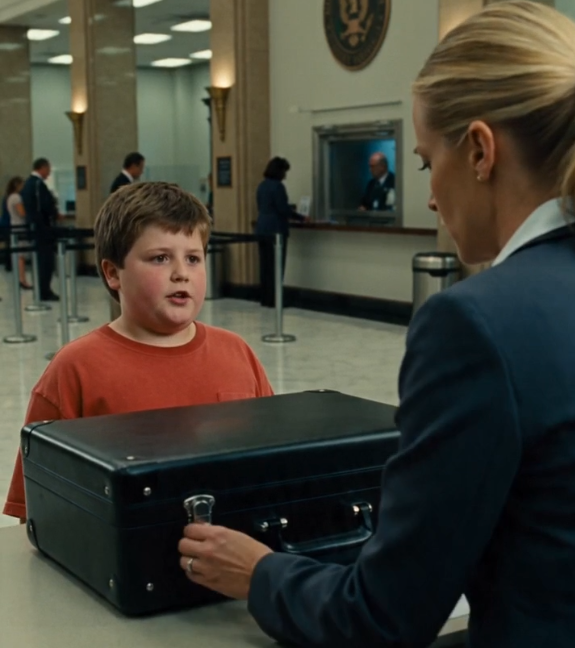
For one full second, no one in the bank moved. The air itself seemed to hold its breath. And then, like a dam breaking, stacks of crisp one-hundred-dollar bills burst outward — thousands of them, banded in neat paper straps, tumbling over the lip of the counter and cascading onto the polished floor. A green rain. A snowstorm of Benjamin Franklins.
Someone screamed. A woman in line dropped her handbag. An elderly man crossed himself. Security guard Dennis Carroway took two steps forward and then stopped, his hand frozen halfway to his radio, because he had never been trained for this.
Margaret couldn’t breathe. Her hands were shaking so hard she had to grip the edge of the counter to stay upright. There had to be — God, there had to be millions in there. More than millions. She looked at the boy. The boy looked back, unblinking, his small mouth set in a line so still it seemed carved.
“What—” Her voice cracked. She swallowed and tried again, louder now, loud enough that the whole lobby heard her. “What is your father’s name?!”
The boy’s lips barely moved.
“Damien Crowe.”
The name landed like a stone dropped into a still pond.
Margaret’s face went white. The color drained from her cheeks so fast that later, watching the security footage, Dennis would swear he saw her age in that single moment. Across the lobby, an older teller named Rose dropped a stack of deposit slips and stumbled backward into her chair. A man in a gray suit who had been waiting for a wire transfer turned slowly toward the boy, and his wedding ring slipped from trembling fingers and rolled across the floor.
Because everyone in that bank — everyone over the age of forty — knew that name.
Damien Crowe had been the president of First National Trust. He had built it, shaped it, sat behind the mahogany door at the end of the executive hall for twenty-three years. He had hired Margaret himself, shaken her hand on her first day, told her she had “the honest eyes of a person who would never steal a dime.”
Damien Crowe had died in a plane crash over the Atlantic.
Thirty-seven years ago.
Margaret’s mouth opened. Closed. Opened again. Her eyes filled with a terror that went beyond confusion, beyond shock — the specific, bone-deep horror of a person watching the laws of the world rearrange themselves in front of her.
“That’s impossible!” she screamed, her voice splintering into the marble silence. “That’s IMPOSSIBLE!”
The boy tilted his head slightly. Just slightly. The way a bird does when it notices something small and curious on the ground.
And then, for the first time since he’d walked in, Tobias smiled.
It was not the smile of a nine-year-old.
“He said,” the boy whispered, “you’d say that.”
He reached into the pocket of his cargo shorts and pulled out a small, yellowed envelope, sealed with red wax. The wax bore an imprint of the First National Trust crest — the old one, retired decades ago. He placed it gently on top of the money.
“He said to give you this, too. And he said—” the boy paused, as if remembering the exact words, “—he said he’s coming to collect what they took from him. On Friday.”
Margaret stared at the envelope. Her hands would not move.
Behind her, through the glass wall of the executive corridor, the door at the end of the hall — the one that had been locked since 1988, the one labeled in faded gold leaf D. CROWE, PRESIDENT — slowly, silently, clicked open.
The boy turned and walked out of the bank, leaving the briefcase, the money, and the envelope behind.
No one stopped him.
No one could.