The Forgotten Heir
Chapter One: The Cold Corridor
King Aldric of Thornwall had not slept in seventeen nights.
The war with the northern clans was over. The treaties were signed, the banners returned to their halls, and the kingdom he had bled for lay quiet beneath a blanket of early winter frost. By all accounts, he should have been at peace.
And yet, each night, he walked.
Down the long stone corridors of Castle Thornwall he paced, past the silent guards who bowed but never spoke, past the tall arched windows where the moon poured its pale blue light onto the flagstones. His burgundy robe trailed behind him like a wound that would not close. His wife, Queen Mirella, had stopped asking where he went. She knew, perhaps better than he did, that some men walk because standing still becomes unbearable.
Tonight, as every night, he walked toward the eastern wing — the wing that had been sealed for twelve years.
He did not know why his feet carried him there. He only knew that something in his chest, something old and buried, pulled at him like a thread unraveling from a tapestry he had long ago stopped looking at.
Chapter Two: The Boy in the Moonlight
The torches guttered as he passed. The wind outside moaned against the castle walls. Aldric pulled his robe tighter and turned the corner into the long gallery where the portraits of his ancestors watched with painted, judging eyes.
He stopped.
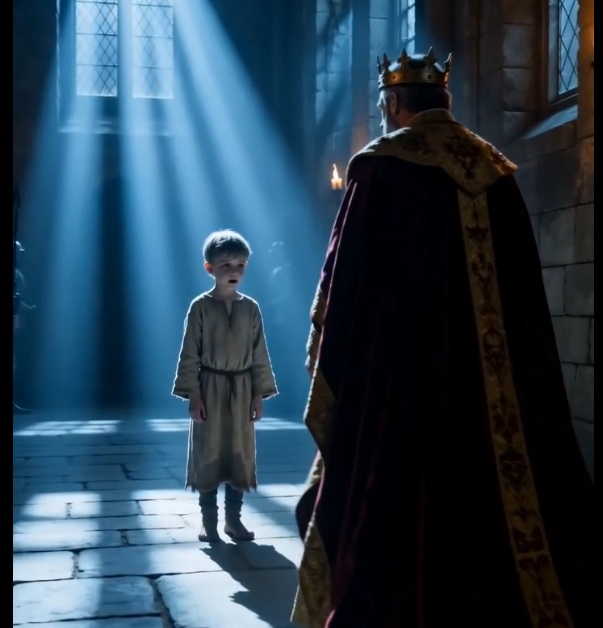
At the far end of the corridor, bathed in a single shaft of moonlight, stood a boy.
He could not have been more than ten years old. His tunic was simple — the kind a commoner’s child might wear — and his face was pale, his dark hair falling soft around his ears. He stood perfectly still, hands at his sides, and he was looking at the King.
Aldric’s hand moved instinctively to the dagger at his belt.
“How did you get here?” His voice was sharper than he intended, echoing off the stone. “The guards — how did you pass the guards?”
The boy did not answer at first. He only tilted his head, the way a child does when trying to understand something an adult has said.
Then he spoke, and his voice was quiet, and clear, and terrible.
“I am your son. The one you forgot.”
Aldric froze.
“You threw me out of your life.”
Chapter Three: The Memory He Had Buried
The King staggered back a step. His hand fell from the dagger. The torches seemed to dim, and the corridor seemed to lengthen, and for a moment Aldric was not a king at all but a young man of twenty-three, standing in a candle-lit chamber above a tavern in the river town of Vell.
Her name had been Elina.
She had been a weaver’s daughter, with laughter like wind through summer wheat, and he had loved her the way young princes love — completely, recklessly, and briefly. When his father the old king had discovered the affair, there had been a choice: the throne, or the girl. Aldric had chosen the throne. He had told himself Elina would understand. He had sent her gold, and then he had sent her nothing, and then he had sent her from his mind entirely.
He had heard, years later, that she had borne a son.
He had heard, years after that, that both she and the child had died of fever in a village whose name he could not now remember.
He had not attended. He had not mourned. He had married Mirella, and fathered three daughters, and built a kingdom, and told himself that the past was a country he no longer needed to visit.
“Elina’s boy,” he whispered now. “You are Elina’s boy.”
The child in the moonlight nodded, slowly.
“I was six years old when the fever came,” the boy said. “Mother called your name. She thought, at the end, that you might come for us. She died still thinking it.”
Aldric’s knees gave out. He sank to the cold stone floor of his own castle, a king kneeling before a child who was not there.
“I did not know,” he said. But even as he said it, he understood that he had not wanted to know. That was the worse sin. Not the forgetting, but the refusing to remember.
“I did not know, Elias,” he whispered — and only then did he realize he had remembered the boy’s name.
Chapter Four: What the Dead Can Give
The boy walked toward him.
His footsteps made no sound on the stone. The guards at the end of the corridor did not turn, did not see, did not move. Only the King saw him, and only the King heard him, and only the King wept.
Elias stopped an arm’s length away. In the moonlight, Aldric could see now that the boy was not solid — that the light passed through him faintly, the way light passes through river mist at dawn.
“I did not come to punish you, Father.”
Aldric looked up.
“I came because you have been walking these halls for seventeen nights, and you do not know why. And I wanted you to know why, before it is too late.”
“Too late for what?”
The boy smiled — and it was the saddest smile Aldric had ever seen, because it was kind.
“You have a son, Father. A living one. Prince Tomas.”
“Tomas is — Tomas is only a boy of seven, he —”
“He watches you from his window when you walk at night. He thinks you are angry with him. He thinks he has done something wrong. He is beginning to believe, the way I once believed, that his father does not love him.”
Aldric’s breath caught in his throat.
“Do not make him into me,” Elias said softly. “Do not let another boy grow up carrying the weight of a father’s silence. I forgave you the moment I understood what you were. But Tomas is still waiting to be seen. Go to him. Tonight. While there is still time.”
The King reached out a trembling hand. For a moment — just a moment — he thought he felt the warmth of small fingers against his own.
And then the moonlight shifted, and the corridor was empty, and he was alone on the cold stone floor with tears running into his gray beard.
Chapter Five: The Father Who Came Home
King Aldric rose.
He did not walk slowly now. He ran — ran through the corridors of his own castle like a man half his age, past startled guards and wide-eyed servants, up the winding stair of the northern tower, to a small wooden door painted with blue stars.
He pushed it open.
Inside, by the dying light of a single candle, a small boy sat upright in his bed. He had been crying. He had, perhaps, been crying for a long time. When he saw his father in the doorway, his eyes grew wide with fear — the fear of a child who expects to be scolded for being awake.
Aldric crossed the room in three strides.
He knelt beside the bed. He took his son’s small face in his weathered hands, and he looked at him — truly looked at him — for what he realized, with a terrible and holy clarity, was the first time.
“Tomas,” he said. His voice broke. “My son. My son, I am so sorry.”
And the boy, understanding nothing and everything at once, threw his small arms around his father’s neck and held on as though he had been waiting all his life for this moment.
Outside the window, the moon passed behind a cloud, and the eastern wing of the castle fell into shadow, and somewhere in that shadow — if anyone had been watching — a small boy in a simple tunic smiled one last time, and was gone.
Epilogue
They say that King Aldric of Thornwall was a different man in his later years.
They say he unsealed the eastern wing of the castle and turned it into a home for orphans of the war. They say he commissioned a portrait of a dark-haired boy in a simple tunic, and hung it in the gallery beside the portraits of kings, and when asked who the child was, he would only answer:
“My firstborn. Whom I found too late, and who found me in time.”
And they say that on quiet winter nights, when the moon is full and the corridors are long and blue with its light, two sets of footsteps can sometimes be heard walking together through the eastern wing —
one heavy, one light,
and neither of them alone.