The Whitmore mansion blazed with light that November evening, every window throwing golden squares onto the snow-dusted lawn. Inside, the annual Whitmore Winter Gala was in full swing. Crystal chandeliers burned overhead. Champagne flowed from silver fountains. Three hundred of Manhattan’s wealthiest — senators, studio heads, old money and new — drifted through the ballroom in a constellation of diamonds and black silk.
At the center of it all stood Charles Whitmore himself. Sixty-two years old, silver hair combed back with surgical precision, tuxedo cut by a tailor in Milan who had dressed three presidents. He raised his glass to a circle of admirers and laughed at something a senator’s wife had said, though he hadn’t really heard her. He never really heard anyone anymore.
Charles Whitmore had built an empire from nothing. Three hotels in the nineties had become thirty by 2010. He owned a publishing house, a champagne label, and a small but profitable airline that flew mostly to places his friends vacationed. He had a wife in Aspen, two grown sons in Connecticut, and a mansion in every city that mattered.
What he did not have, and had not had for twenty-two years, was the thing he never spoke about.
The side door to the kitchen burst open at half past nine.
A small figure slipped through — no more than nine years old, wrapped in a coat three sizes too large, the wool torn at the elbow and frayed at the hem. Her shoes were cracked. Her face was streaked with the grey of long cold days. Brown hair tangled around her cheeks in a way no mother had combed in weeks.
She should not have been there. A caterer had left the service entrance propped open to cool the kitchen, and the girl had slipped past three staff members in the chaos of the dessert course. She walked with quiet, steady purpose through the back halls, past the wine cellar, past the coatroom, and out into the ballroom itself — where she stopped, blinking, at the edge of a forest of legs in silk and wool and patent leather.
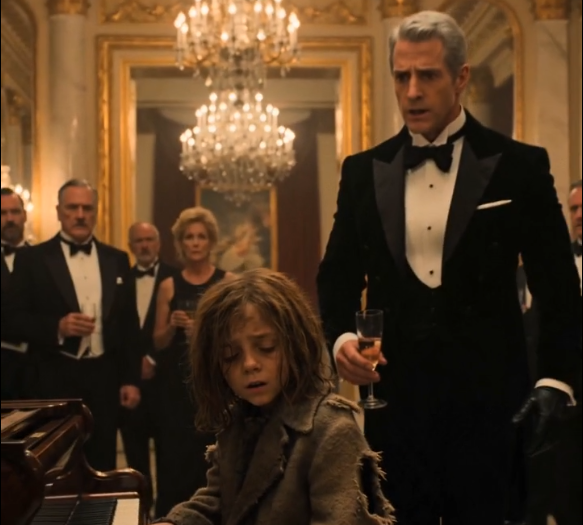
The first guest to see her was a woman in emerald satin, who gasped and stepped back as if the girl were a spider. The second was a studio executive, who laughed — a short, cruel bark of laughter — and pointed. Others turned. A ripple spread through the crowd, that particular ripple that money makes when it encounters something it does not understand.
The girl did not run. She looked, instead, across the room — over the heads of men, past the shoulders of women — until she found what she had come for.
The piano.
It stood at the far end of the ballroom: a magnificent mahogany Bösendorfer, the keys gleaming like teeth under the chandelier. She walked toward it. The crowd parted for her the way crowds part for things they cannot name. No one stopped her. Everyone watched.
She reached the piano and climbed onto the bench. It was too high for her. Her feet dangled several inches above the pedals. She placed her hands carefully on her knees and looked out at the room — at the rings and the glasses and the staring faces — and she spoke.
Her voice was soft but clear, the way a bell is clear.
“I’ll play for you,” she said. “Just feed me. Please.”
The room, for the first time that evening, went quiet.
Charles Whitmore heard the silence before he understood it.
He had been mid-sentence with a congressman when the murmur around him fell away. He turned, frowning, expecting perhaps a waiter who had dropped a tray, or some minor scandal involving someone’s wife. What he saw instead was a child. A filthy child. At his piano. In his ballroom.
Something cold moved through him — the cold he had spent thirty years cultivating, the cold that had made him rich. He set his champagne glass on a passing tray with a decisive click and strode forward. The crowd parted again, this time for him.
He stopped three feet from the bench. The girl looked up at him. Her eyes were very large, and very dark, and very steady.
“Get out of here,” he said. His voice was not loud, but it did not need to be. He had learned long ago that real power never raised its voice.
The girl did not move.
“Did you hear me?” He pointed at the service hall. “Out. Before I call someone to drag you out.”
Still, she did not move. She looked at him for a long moment, as if measuring something she alone could see. Then, without taking her eyes from his, she slowly raised her hands from her knees.
And she placed them on the keys.
The first note was a low D.
It hung in the air of the ballroom for what seemed a long time — richer and deeper than any note had a right to be, drawn from the instrument by a hand that knew precisely where to press and how long to hold. Then came the second note. Then the third.
And then the melody began.
It was Chopin. The Nocturne in E-flat major, Opus 9, Number 2 — but played not as a party piece, not as the pleasant background music of a hundred hotel lobbies. Played as Chopin himself might have played it, had Chopin been a child with hunger in her stomach and winter in her bones. The notes were slow and aching and unbearably tender. They climbed and fell and climbed again. Each phrase was a small confession. Each rest was a held breath.
The ballroom did not move. Three hundred wealthy Americans stood with their champagne glasses half-raised and forgot to drink. The senator’s wife began, silently, to cry. The studio executive who had laughed earlier stared at the girl with his mouth slightly open. Somewhere near the back, a waiter set down his tray and did not pick it up again.
Charles Whitmore had not moved either.
He stood three feet from the piano bench, champagne forgotten on the tray behind him, and he watched the small dirty hands move across the keys, and something inside his chest began to come apart.
It had been twenty-two years since he had last heard that piece played that way.
Twenty-two years since a woman in a yellow dress had sat at a piano in a conservatory in Vienna, her long fingers moving across the keys with exactly that touch, exactly that phrasing, exactly that impossible grief. He had been thirty-eight years old. He had been married already. She had been a scholarship student — a poor girl from Ohio with an apartment on the fifth floor of a walk-up and a gift that had made grown men weep in recital halls. He had told her he would leave his wife. He had meant it, at the time.
He had not left his wife. He had returned to New York. He had sent a letter, months later, with a check inside it, when he learned. The check had been returned uncashed. The letter had never been answered. The woman — Amanda, her name had been Amanda, God, he had not said her name aloud in so long — had disappeared from every record he could find. He had stopped looking, eventually. He had told himself it was kinder.
The girl at the piano played on.
The melody lifted into its second theme, that heartbreaking rise, and Charles Whitmore felt his knees go soft beneath him. The girl’s hair fell across her face as she leaned into the keys. Her feet dangled above the pedals. Her coat was torn at the elbow.
Her fingers. Her fingers.
He knew those fingers.
The last note fell. It hung in the air, trembling, and then it was gone.
The silence that followed was the deepest silence the Whitmore ballroom had ever held.
The girl lowered her hands slowly to her lap and looked up at him.
Charles Whitmore’s voice came out as barely a whisper. His mouth was dry. His hands were shaking in a way that had not happened to him since he was a boy.
“Who —” He could not finish. He tried again. “Who taught you this?”
The girl looked at him with those very dark, very steady eyes.
“My mother,” she said.
The champagne glass slipped from the tray behind him and shattered on the marble floor. Someone gasped. Charles Whitmore did not hear it.
“Your mother,” he repeated. His voice did not sound like his own.
The girl nodded.
He took one step toward her. Just one. His legs did not feel like legs.
“What — what was her name? Your mother’s name. Tell me her name.”
The girl tilted her head slightly, the way a child does when she is trying to decide whether to trust someone.
“Amanda,” she said.
The ballroom dissolved around him. The chandelier, the guests, the marble, the champagne — all of it went grey and distant, as if he were watching his own life from the wrong end of a telescope. He heard, very faintly, his own voice saying something. A word. A single impossible word.
“Amanda.“
The girl’s eyes filled, suddenly, with tears. She did not wipe them away.
“She died last winter,” she said. Her small voice did not shake. “In the room we rented. She was sick for a long time. Before she died, she told me to find you. She said — she said if I ever needed help, and I had no one left, I should come here and play this song. She said you would know.”
Charles Whitmore sank to his knees on the marble floor of his own ballroom. Three hundred of the wealthiest people in America watched in absolute silence as the richest man any of them knew knelt before a starving child in a torn coat and wept — wept as none of them had ever seen a man weep, with his face in his hands and his shoulders shaking like a boy’s.
The girl sat very still on the piano bench. She looked down at him — this stranger, this man her mother had whispered about with the last breath she had — and her small dirty hand reached out, hesitantly, and rested on the top of his silver head.
“Are you,” she said softly, “are you my father?”
Charles Whitmore could not speak. He could only nod, his face still in his hands, as twenty-two years of a life he had never quite managed to stop thinking about came pouring out of him onto the marble floor.
The girl climbed down from the piano bench. Her cracked shoes made a small sound on the marble. She stood in front of him — this child he had never known he had, this child who had walked through the snow to find him, this child who carried her mother’s hands and her mother’s gift and her mother’s grief.
She put her small arms around his neck.
“It’s okay,” she whispered into his silver hair. “It’s okay. I found you.”
And in the silent ballroom, beneath the burning chandeliers, surrounded by three hundred strangers who would tell this story for the rest of their lives, Charles Whitmore held his daughter for the first time, and did not let go.