The Bracelet at Dawn
Chapter One — The Garden
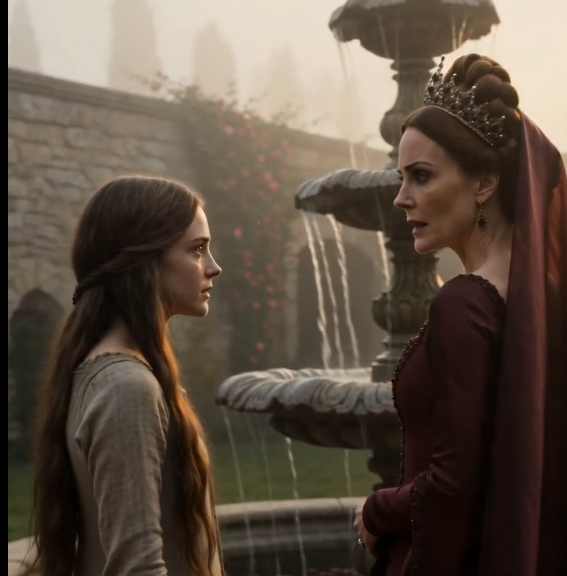
Queen Isolde walked the garden path at first light, as she had done every dawn for twenty years.
The roses were heavy with dew. The fountain whispered its old song. Somewhere beyond the eastern wall, the bells of the chapel began their slow morning prayer. This was her hour — the only hour the crown did not weigh upon her.
She turned the corner near the fountain, expecting solitude.
Instead, a young woman stood there.
The Queen stopped. Her guards, far behind, saw nothing amiss and did not approach. For a long moment, only the fountain spoke.
“Who are you?” Isolde asked, her voice soft with confusion.
The young woman turned slowly. She wore the coarse linen of a peasant, and her face was shadowed with a long journey’s fatigue. But her eyes — her eyes were the color of river stones in summer. Familiar eyes. Eyes the Queen had not seen in two decades.
“The one they told you never lived,” the young woman said.
Isolde took a step forward. Then another. Her hand rose, trembling, to her own throat.
“That’s impossible…”
The young woman reached into the folds of her dress and lifted a small object into the morning light. A bracelet. Gold, delicate, worked with the sigil of the House of Velaren — a swan breaking from a closed crown. The Queen knew that bracelet. She had made it herself, with her own hands, twenty-one years ago, in the weeks before the birth.
“Then why,” the young woman said, her voice steady and calm, “was this buried with my mother?”
Chapter Two — What Was Buried
The Queen sank onto the stone rim of the fountain. She did not weep. She had forgotten how.
“Your mother,” she said.
“Mara. She raised me in a fisher’s village on the northern coast. She died last winter. I found the bracelet in a wooden box beneath her bed, wrapped in a lock of hair. My hair. Cut from my head when I was an infant.” The young woman’s voice did not shake. “She left a letter. It said I was to come here. It said I was to ask the Queen why a newborn’s bracelet was given to a dying servant to hide.”
Isolde closed her eyes.
Twenty-one years ago, she had given birth in a locked chamber, in secret, while the King was at war. The child — a daughter — had been born too early. The midwife had taken the infant away to be cleaned and warmed. She had returned an hour later, her face gray, and told the Queen that the child had not survived.
Isolde had believed her. She had mourned for a year. She had buried an empty coffin beneath the chapel stones and laid roses upon it every spring.
“Mara was my midwife,” the Queen whispered.
“Yes.”
“She told me you were dead.”
“Yes.”
“Why?”
The young woman knelt before her. Not in reverence — in weariness.
“Her letter said the King had given the order. Before he rode to war, he told her that if the child was a girl, she was to be taken away and hidden. He wanted a son. He said a second daughter would weaken the line. Mara could not kill me. So she told you I had died, and she ran.”
Isolde pressed her hand to her mouth.
Her husband had been dead eleven years. She had grieved him. She had ruled in his name, and then in her own, and she had believed — truly believed — that the great sorrow of her life was behind her.
“What is your name?” she asked.
“Mara called me Lira.”
Lira. The name the Queen had chosen, in secret, for the daughter she had lost. A name she had never spoken aloud to anyone.
Chapter Three — The Choice
They sat together on the fountain’s edge as the sun climbed over the garden wall. The mist burned away. The bells fell silent. The guards kept their distance, sensing, as guards sometimes do, that something was happening they were not meant to witness.
“I did not come for a crown,” Lira said at last. “I came because my mother — Mara — told me I deserved to know the truth. And because you deserved to know I was alive.”
“You are my daughter.”
“I am a fisherman’s daughter. I mend nets. I know the names of every current between the headlands. I have a sister named Bryn who cannot read and a brother named Toma who laughs too loud. That is my family.” Lira looked down at the bracelet in her palm. “But I am also yours. And I wanted you to see me once.”
Isolde took the bracelet from her hand. She turned it in the light. The swan was still bright. The crown was still broken. She had made it as a promise to a child she would never meet.
She fastened it, gently, around her daughter’s wrist.
“Stay the morning,” the Queen said. “Only the morning. Walk with me. Tell me about the sea. Tell me about Bryn and Toma. Tell me about your mother — about Mara — and what kind of woman she became after she ran. And then, if you wish to return to your nets and your currents, I will give you a horse and a purse of gold and my blessing, and no one will ever know you were here.”
“And if I wished to stay?”
Isolde smiled for the first time in a long while. It was a small smile, and a sad one, but it was true.
“Then I would learn, at last, how to be a mother. Twenty-one years late. And badly, I expect. But I would try.”
Lira considered this. She looked at the garden — the roses, the fountain, the long stone path leading back toward the palace. Then she looked at the eastern wall, beyond which lay the road, and the coast, and the small grey house where a brother laughed too loud and a sister mended nets by candlelight.
“Walk with me,” she said. “And then I will decide.”
And so the Queen and the fisherman’s daughter walked together through the garden at dawn, and the sun rose fully over the roses, and for one morning at least, nothing in the kingdom was more important than the quiet sound of two voices learning, for the first time, how to speak to one another.
Epilogue
What Lira decided, that morning, is a story for another day.
But the bracelet — the small gold bracelet with the swan and the broken crown — was never buried again.