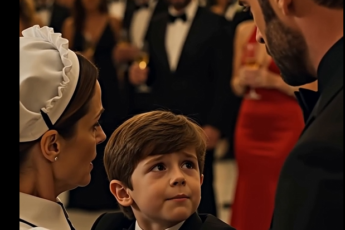
The October wind cut sharp down Fifth Avenue, carrying with it the smell of roasted chestnuts, wet asphalt, and the particular indifference of a city that had long ago learned to look away.
Aleck sat where he always sat — the corner of 47th and 8th, his back against the cold brick of a deli that smelled of yesterday’s bread. He was seven, though he was small enough to pass for five, and he had been sitting on this corner for as long as he could remember, which was not very long at all. His earliest memory was of a man with a gold tooth telling him his name was Aleck and that he was lucky to have a roof at all. The roof had been a leaking ceiling above a mattress in a basement in Queens, and the man had not been kind, and one morning the man had simply not come back. Aleck had walked until his legs gave out, and the corner of 47th and 8th was where they gave out.
He held a cardboard sign that he had drawn himself in shaky letters: PLEASE HELP — I’M HUNGRY.
Around his neck, on a thin tarnished chain that had turned his skin green in places, hung a small silver heart-shaped locket. He had worn it for as long as he had been Aleck. The man with the gold tooth had said it was junk, but had never taken it off him, and Aleck had learned early not to ask why. He had tried to open the locket once, when he was small enough to still believe in things, but it had been stuck shut, and he had not tried again.
The pedestrians moved past him in waves. Women in heels. Men in suits with phones pressed to their ears. Tourists with cameras. None of them looked down. He had learned that this was not cruelty, exactly. It was only that to look down was to see, and to see was to have to do something, and most people were too tired to do something. So they looked at the sky, or their phones, or the middle distance, and Aleck became part of the sidewalk.
“I’m hungry,” he said quietly, to no one in particular. “Please help me.”
It was 4:47 in the afternoon, and the sun was beginning its slow tilt behind the buildings, painting the avenue in that peculiar Manhattan gold that photographers chase and never quite catch. Steam rose from a manhole across the street like a ghost trying to remember its name.
Then he saw the heels.
They were red on the bottom, the kind of red that meant something he didn’t understand, and they belonged to a woman in a coat the color of warm milk. She was the kind of woman who did not stop. Aleck knew this immediately. She walked the way wealthy women walk — purposefully, eyes forward, the city arranged for her convenience.
But she stopped.
She stopped, and she turned, and she looked down.
Her face, when he saw it, was beautiful in a way that made him think of magazines he had seen blowing across the street. Auburn hair pulled back. Diamond earrings catching the light. A face that had never known a winter without a coat. She crouched, slowly, careful of her coat, and she smiled at him — not the pitying smile he was used to, but something softer, something almost confused, as if she had bent down to pick up a coin and found something else entirely.
“Here, sweetheart,” she said. Her voice was warm, low, the voice of someone who read aloud to children at bedtime, though Aleck had never been read to and didn’t know to recognize it. “Take this.”
She held out a folded bill. A twenty. He had never held a twenty.
He reached for it, and as he did, she tilted her head slightly, and her eyes — they had been looking at his face, and now they were looking at his chest. At the locket.
She went very still.
“Where did you get this?” she asked. Her voice had changed. It was not unkind, but something underneath it had cracked open.
Aleck shrugged. He had no answer. The locket had always been there, the way his hands had always been there.
Her fingers — manicured, trembling now in a way they had not been trembling a moment before — reached out and lifted the locket from his chest. She turned it in her palm. He watched her thumbnail find the small clasp that he had never been able to open, and he watched her press it, and he heard the small metallic click that he had spent his whole short life waiting to hear without knowing it.
The locket opened.
For a long moment, the woman did not breathe.
Inside the locket was a photograph, faded and small. A younger version of the woman crouching in front of him — perhaps ten years younger, her hair longer, her face unlined — laughing, holding a baby against her cheek. The baby had a tuft of dark hair and a small, crooked smile, and the woman in the photograph was looking at the baby the way people in paintings look at things they will love forever.
The woman on the sidewalk made a sound. It was not a word. It was the sound a person makes when the floor of the world drops out from underneath them and they discover, in the falling, that there is something beneath the floor they had never known was there.
The city went quiet around them. The taxis still moved. The pedestrians still walked. But for Aleck and for the woman, the sound dropped away as if someone had put the world inside a glass jar.
She looked at him. Really looked. Her eyes traced his face — the shape of his nose, the set of his eyes, the small crooked thing his mouth did when he was confused, which he was now, terribly. She brought a hand to her mouth. Tears were already on her cheeks; she had not noticed them start.
“Aleck,” she whispered.
He did not understand. No one had said his name like that before. As if the name itself were a wound. As if the name itself were a homecoming.
“Aleck,” she said again, and this time the word broke in half, “I found you.”
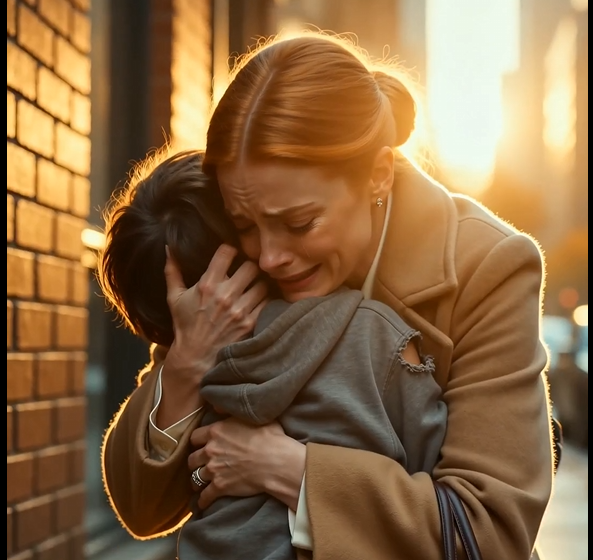
She pulled him into her arms then, and Aleck, who had not been held in any way he could remember, who had spent his whole life on the cold side of every window, did not know what to do with his hands. They hung at his sides for a moment, useless. Then, slowly, the way a small animal that has never known a kind hand will eventually lean into one, his arms rose and went around her neck, and he pressed his dirty face into the cashmere of her shoulder, and he did not know why he was crying, only that he was, and that the woman was crying too, and that her tears were warm and her hands were shaking and she was whispering his name over and over like a prayer she had been saving for seven years.
Around them, Manhattan kept moving. The taxis honked. A flag flapped on a building across the street. The sun went lower.
But on the corner of 47th and 8th, a woman in a cashmere coat sat on the dirty sidewalk in her red-bottomed heels and did not let go of the small homeless boy in her arms, and the small homeless boy did not let go of her, and somewhere inside the silver locket between them, a photograph that had waited seven years finally, finally, had nothing left to wait for.
Her name was Eleanor Ashford-Vance, and seven years ago her son had been taken from a stroller outside a café in Tribeca while she paid for a coffee. The police had searched. The FBI had searched. The story had been on the news for nine days and then it had not been on the news anymore, because there is always a new story, and Eleanor had spent seven years walking past every dark-haired boy on every sidewalk in every city, and she had stopped looking the way you stop looking for a thing you have decided to survive without.
She had only stopped today because something — she would never afterward be able to say what — had told her to.
And Aleck, who had been called other things before he was Aleck, who had been taken at twenty-one months old by a man who had owed the wrong people money and decided a child was a thing he could sell, who had been passed through hands and basements and forgotten corners until he had been forgotten even by the man who took him, Aleck did not yet understand what had just happened to his life.
He only knew that the woman smelled like something he had no word for, something clean and warm and impossibly familiar, like a song you have not heard since before you had language for songs.
He only knew that when she pulled back to look at his face, she was smiling and crying at the same time.
He only knew that she said, “I’m taking you home, baby. I’m taking you home.”
And that for the first time in seven years, the word home meant something true.
Eleanor never let the locket leave her sight for the next six months. It sat on her nightstand, opened, the photograph facing up, until the day she didn’t need it anymore — the day Aleck, asleep in the bedroom that had been waiting for him for seven years, finally believed that when he woke, she would still be there.
The locket had been a gift from her own mother on the day Aleck was born. Inside, beneath the photograph, engraved in tiny letters his mother had once chosen, were three words he would learn to read in the months to come.
Three words that had been pressed against his small chest every cold night of his small forgotten life, waiting.
Always come home.