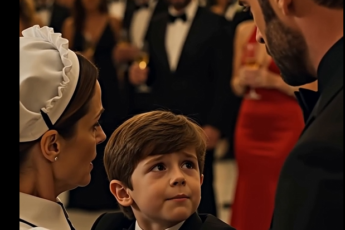
The ballroom of the Manhattan Royal Hotel glittered as if the city itself had been invited inside.
Crystal chandeliers hung above hundreds of guests dressed in black tuxedos and designer gowns. Champagne glasses clinked softly. A jazz band played near the stage beneath a large American flag and a gold banner that read:
Annual Children’s Foundation Gala — New York City
Everyone smiled for cameras. Everyone pretended to care.
But the most important guest in the room had not smiled once.
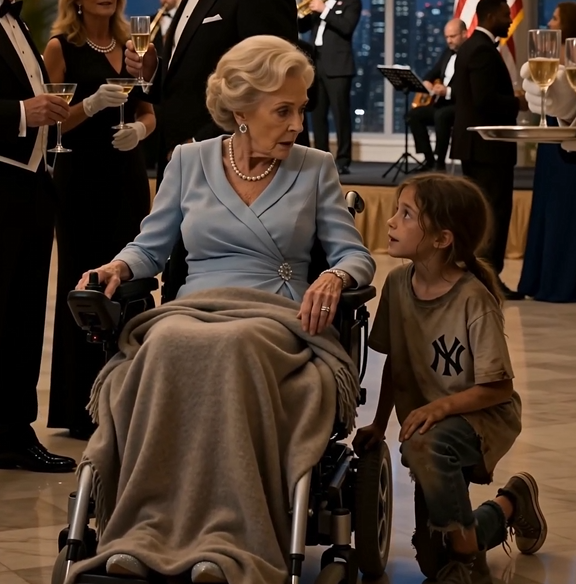
Eleanor Whitmore sat near the front of the ballroom in a sleek motorized wheelchair, wrapped in a pale blue evening gown and a cashmere throw. At seventy-two, she was still beautiful in the way old money teaches people to be beautiful — elegant, controlled, untouchable.
To most of New York, she was a legend.
She had built hospitals, funded schools, donated millions to children’s charities, and helped raise her only son, Richard Whitmore, into one of the richest businessmen in America.
But for the past nine years, Eleanor had not taken a single step.
Doctors called it impossible.
Her son called it tragedy.
Eleanor never called it anything.
She simply sat in silence whenever people spoke about her condition, her fingers resting calmly on the armrests of her wheelchair, her eyes always looking somewhere far away.
That night, Richard stood beside her in a perfect black tuxedo, greeting donors with a practiced smile.
“My mother is the heart of this foundation,” he told the crowd from the stage. “Everything we do is because of her.”
The room applauded.
Eleanor lowered her eyes.
She knew better than anyone that applause could hide the ugliest secrets.
The gala continued. Waiters moved through the crowd with silver trays. Wealthy guests whispered about donations, business deals, and summer houses in the Hamptons.
Then, unnoticed by nearly everyone, a little girl slipped through the ballroom doors.
She was small, no older than eight.
Her face was smudged with dirt. Her oversized Yankees T-shirt hung from her thin shoulders. Her jeans were torn at the knees, and her sneakers looked as if they had survived too many winters.
A security guard saw her and frowned.
“Hey. You can’t be in here.”
But before he could reach her, the little girl disappeared between the guests like a shadow.
She moved with strange confidence — not frightened, not lost.
She was looking for someone.
Then she saw Eleanor.
The old woman sat beneath the golden light, separated from the crowd by wealth, status, and sadness.
The little girl walked straight toward her.
A few guests noticed.
“Whose child is that?”
“Is she part of the program?”
“Security should remove her.”
But the girl ignored them all.
She stepped beside Eleanor’s wheelchair and slowly knelt on the polished marble floor.
Eleanor looked down.
Their eyes met.
For the first time that evening, the old woman’s expression changed.
Not fear.
Recognition.
The little girl whispered, “I can help you walk again, ma’am.”
The nearby conversations died instantly.
Richard turned from the donors.
“What did you say?” he asked sharply.
The girl did not look at him.
Eleanor’s lips parted.
“Who… who are you?” she whispered. “How did you get in here?”
The girl reached into the collar of her faded shirt and pulled out a small silver locket.
It was old, scratched, and shaped like a rose.
Eleanor stared at it.
The color drained from her face.
Richard stepped forward quickly.
“Security,” he said, his voice tight. “Remove this child.”
But Eleanor raised one trembling hand.
“No.”
The entire ballroom froze.
The girl opened the locket.
Inside was a tiny photograph of a young woman with auburn hair, holding a newborn baby wrapped in a blue blanket.
Eleanor’s breathing changed.
“Where did you get that?” she asked.
“My grandmother gave it to me before she died,” the girl said softly. “She told me to find the lady in the blue dress.”
Richard’s face went pale.
Eleanor slowly reached toward the locket, but her fingers shook so badly she could barely touch it.
“What was your grandmother’s name?” she whispered.
The girl looked at her.
“Margaret.”
The name moved through the ballroom like a cold wind.
Eleanor closed her eyes.
Thirty-eight years earlier, Margaret had been Eleanor’s personal nurse.
But she had not only been a nurse.
She had been the only person Eleanor trusted.
And the only person who knew what had truly happened the night Eleanor’s daughter was born.
Because Richard Whitmore was not Eleanor’s only child.
Years ago, Eleanor had given birth to a baby girl — a fragile child with weak lungs. Richard, already a young man then, had been furious. A daughter meant sharing the inheritance. Sharing the company. Sharing their mother’s love.
One stormy night, Eleanor was told the baby had died.
A tiny coffin was buried.
A funeral was held.
And Eleanor never walked again after that day.
Not because her legs were broken.
But because her soul was.
The little girl placed her hand gently on Eleanor’s knee.
“Grandma Margaret said you didn’t lose her,” the child whispered. “She said they lied.”
Richard’s smile vanished completely.
“That’s enough,” he said.
His voice was no longer polished.
It was dangerous.
Eleanor looked up at him.
“What is she talking about?”
Richard gave a cold laugh. “Mother, she’s a street child. Someone sent her here for money.”
The girl shook her head.
“She also told me one more thing.”
Richard’s eyes narrowed.
The girl looked at Eleanor and said, “She said the man who told you your baby died… is standing next to you.”
The ballroom erupted in whispers.
Eleanor turned slowly toward her son.
Richard’s face was still, but his hand had tightened around his champagne glass.
Then the little girl closed her eyes.
“One…” she whispered.
Eleanor gasped.
Her fingers dug into the wheelchair armrests.
“Two…”
The cashmere throw slid from her knees to the marble floor.
Guests stepped back in shock.
Eleanor felt something she had not felt in nine years.
Pressure.
Warmth.
Pain.
Life.
“Three.”
Her feet moved.
Only slightly.
But they moved.
A woman screamed.
Richard dropped his glass. It shattered across the floor.
Eleanor leaned forward, trembling, her body lifting just an inch from the wheelchair.
But she did not stand.
Not yet.
Because at that exact moment, the little girl opened the locket again and turned it around.
Behind the photograph was a folded hospital bracelet, yellowed with age.
Eleanor took it with shaking hands.
The name on it was not Margaret’s.
It was not the little girl’s.
It was the name of the baby Eleanor had buried thirty-eight years ago.
Rose Whitmore.
Eleanor looked at the child.
The little girl’s eyes filled with tears.
“My mother’s name was Rose,” she whispered. “She died last winter.”
Eleanor’s face collapsed.
The room went silent.
Richard backed away.
The little girl reached into her pocket and pulled out one final thing — a small recorder.
“My grandmother said I should only play this when I found you.”
She pressed the button.
An old woman’s weak voice filled the ballroom.
“Eleanor… forgive me. Richard paid the doctor. Your daughter lived. I took the child away because I feared he would kill her. I raised her in secret until I could find a way to tell you. But I waited too long…”
Eleanor began to cry without sound.
The recording continued.
“And if her daughter ever finds you… do not trust Richard. He did not only steal your child. He has been poisoning you for years so you would never walk into a courtroom and take back what was yours.”
Every guest turned toward Richard.
His face had gone white.
The wealthy businessman, the beloved philanthropist, the perfect son — suddenly looked like a cornered animal.
Eleanor stared at him.
Then, with tears streaming down her face, she gripped the armrests again.
This time, not from fear.
From fury.
Her legs trembled.
The little girl held her hand.
And in front of all of Manhattan, Eleanor Whitmore slowly rose from her wheelchair.
Not completely steady.
Not without pain.
But standing.
The ballroom exploded into gasps.
Richard tried to run.
He made it three steps before two security guards grabbed him.
Eleanor did not look at him again.
She looked only at the child.
“What is your name?” she whispered.
The little girl wiped her tears.
“Lily.”
Eleanor pulled her close, trembling as she embraced the granddaughter she never knew existed.
For the first time in nine years, she was standing.
But for the first time in thirty-eight years, she was whole.
The next morning, every newspaper in New York printed the same headline:
Billionaire Philanthropist Arrested After Child Exposes Family Secret at Charity Gala
But the reporters missed the strangest part.
Doctors later tested Eleanor and found no miracle cure.
No medical explanation.
No hidden surgery.
No drug that could suddenly reverse her condition.
Only one detail remained impossible.
When Eleanor asked Lily how she knew counting to three would make her move, the little girl gave the same answer every time.
“Mommy told me in a dream,” she said.
Then she opened the old silver locket one last time.
Behind Rose’s photograph, where there had been nothing the night before, a new inscription had appeared.
Four tiny words, written in Rose’s handwriting:
She was never alone.