The crowd had come for blood, thunder, and spectacle.
By sunset, the old rodeo arena on the edge of Dallas was already packed so tightly that people stood shoulder to shoulder along the fences. American flags waved above the stands. Stadium lights burned white against the dusty Texas sky. Vendors shouted over the music. Children sat on their fathers’ shoulders. Cameras were raised before anything had even happened.
Everyone had heard the rumor.
Tonight, a bull was coming out that no rider had ever stayed on.
They called him Black Hurricane.
He was almost a legend in the rodeo world — a massive black bull with scarred shoulders, wild eyes, and a temper that seemed too intelligent to be called animal instinct. Three professional riders had been hospitalized trying to handle him. One had never competed again. After that, no one wanted to face him.
But the owner of the arena knew fear sold tickets better than courage.
So he made a show of it.
In the center of the arena, under the blinding lights, the announcer stepped forward with a microphone in his hand. He was a broad man in a white cowboy hat, his voice booming through every speaker.
“Ladies and gentlemen,” he said, letting the crowd quiet down, “tonight, we have a challenge unlike anything this arena has ever seen.”
The crowd roared.
Behind the steel gate, something heavy slammed against the metal.
Once.
Twice.
The sound rang through the arena like a warning.
The announcer smiled, but even he glanced nervously toward the gate before continuing.
“Whoever steps into this arena against this bull…” He paused dramatically. “Wins one million dollars.”
For one second, the entire stadium exploded.
People screamed. Men stood up. Some laughed like the idea was impossible. Others shouted names of famous riders sitting in the VIP section. The cameras turned toward them, waiting for a hero.
But none of them moved.
Not one.
Because behind that steel gate, Black Hurricane struck the metal again, and this time the whole gate shook.
Then it opened.
The bull burst into the arena like something released from a nightmare.
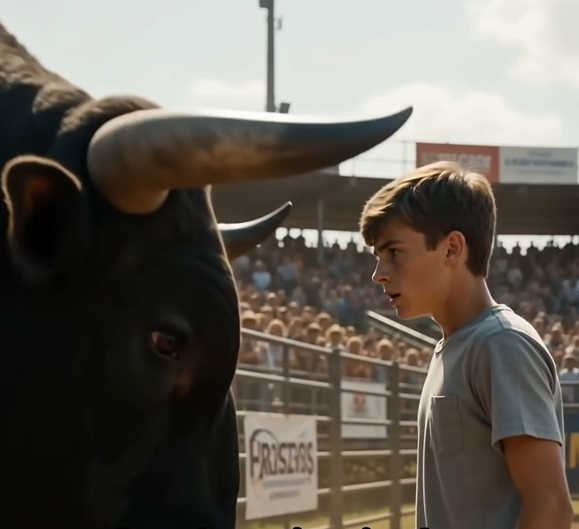
He was enormous — bigger than most people had imagined. His black coat glistened under the stadium lights. Dust flew beneath his hooves. His horns curved forward like polished bone knives. He lowered his head and charged at the empty dirt, tossing it into the air as the crowd’s excitement turned into real fear.
The announcer took a step back.
The arena workers climbed quickly behind the fence.
Even the professional riders looked away.
The million dollars waited in silence.
Then, from the front row, someone jumped.
At first, people thought it was part of the show.
A boy landed in the dirt.
He was thin, no more than sixteen, wearing faded jeans, old boots, and a plain gray hoodie. He had no helmet. No rope. No protective vest. Nothing a rider should have had. He simply stood there, dust around his feet, staring at the bull.
The crowd went silent so suddenly that the sound of the bull’s breathing filled the arena.
The announcer shouted, “Kid! Get out of there!”
But the boy did not move.
Black Hurricane turned.
His wild eyes locked on the boy.
For a moment, nobody breathed.
The bull scraped one hoof through the dirt.
The boy slowly raised his hand.
The crowd gasped.
Security rushed along the fence, but they were too far away. The announcer kept yelling, his voice cracking through the speakers. Somewhere in the stands, a woman screamed.
The bull charged.
The ground shook beneath him.
People covered their eyes.
But the boy did not run.
He only whispered one word.
“Midnight.”
The bull stopped.
Not slowed.
Stopped.
His hooves dug into the dirt just a few feet from the boy. Dust rolled past them like smoke. The animal’s nostrils flared. His head lowered. His entire body trembled with power.
The boy stepped closer.
“No,” someone whispered from the stands. “Don’t…”
But the boy walked straight to him.
Then he placed his small hand on the bull’s forehead.
The arena froze.
Black Hurricane did not attack.
The boy leaned closer and whispered again, too softly for anyone to hear.
And then the impossible happened.
The monster that had terrified grown men closed his eyes.
The boy rested his forehead gently against the bull’s head, and for a few seconds, under the stadium lights, the most dangerous animal in Texas stood perfectly still.
The crowd did not cheer.
They were too shocked.
Then an old man in the VIP section suddenly stood up.
His face had gone pale.
He pushed past the people beside him, gripping the railing as if his legs might fail. Everyone knew him. He was Caleb Warren, the wealthy ranch owner who had bought Black Hurricane three years earlier and turned him into a rodeo legend.
He pointed at the boy with a shaking hand.
“Who are you?” he shouted.
The boy looked up.
For the first time, the cameras caught his face clearly.
And Caleb Warren nearly collapsed.
Because the boy had the same gray eyes as his daughter.
His daughter, Emily, who had disappeared sixteen years ago.
The announcer lowered the microphone.
The crowd began to murmur.
The boy reached into his hoodie and pulled out a small, old photograph. It showed a young woman standing beside a black calf, smiling with her arms around its neck.
Caleb stared at the photo.
His lips parted.
“That calf…” he whispered.
The boy nodded.
“My mother raised him,” he said. “Before you sold him.”
Caleb’s eyes filled with tears. “Your mother?”
The boy swallowed hard.
“She died last winter,” he said. “But before she did, she told me if I ever needed help, I should find the man who stole everything from her.”
The entire arena went still.
Caleb shook his head. “No… no, that’s not true.”
The boy’s voice did not rise, but it carried through the silence.
“She said you didn’t know about me.”
The old man’s face changed.
The anger left first.
Then the pride.
Then something deeper broke behind his eyes.
The boy held out a folded letter.
“She said this would prove it.”
Caleb climbed down into the arena himself, ignoring security, ignoring the cameras, ignoring the thousands of people watching. He took the letter with trembling hands.
When he opened it, the first line was enough.
His knees weakened.
The letter was from Emily.
His daughter.
She had not run away because she hated him, as he had believed for sixteen years. She had left because someone in his own family had paid her to disappear — to keep a scandal away from the Warren name. She had been pregnant. Alone. Afraid. And all those years, Caleb had mourned a daughter who was still alive just a few towns away.
Until it was too late.
Caleb looked at the boy.
The boy looked back at him with the same eyes Caleb had spent sixteen years trying to forget.
“What’s your name?” Caleb whispered.
The boy hesitated.
Then he said, “Eli Warren.”
The old man covered his mouth.
Around them, the arena remained silent.
Black Hurricane, the beast no one could control, lowered himself onto the dirt beside the boy like an old friend.
And only then did everyone understand.
The boy had not stepped into the arena for the million dollars.
He had come because the bull was the last living thing that still remembered his mother.
Caleb slowly took off his hat, tears running down his face.
“The money is yours,” he said.
But Eli shook his head.
“I don’t want your money.”
Caleb stared at him, broken.
“Then what do you want?”
Eli looked at the crowd, then at the bull, then finally back at the old man.
“I want you to say her name,” he said. “In front of everyone. I want the world to know she existed.”
For the first time in his life, Caleb Warren had nothing powerful to say.
So he simply turned toward the cameras, his voice shaking, and spoke the truth.
“My daughter’s name was Emily Warren,” he said. “And I failed her.”
The crowd stood slowly.
Not cheering.
Not shouting.
Just standing.
A quiet respect passed through the arena like wind over grass.
Eli turned to leave, but Caleb reached for him.
“Please,” the old man whispered. “Don’t go.”
Eli stopped.
For a long moment, he said nothing.
Then Black Hurricane suddenly rose behind him.
The crowd stepped back in fear.
But the bull did not charge.
He walked slowly to Caleb Warren, lowered his huge head, and pressed it gently against the old man’s chest — exactly the way he had once done with Emily in the photograph.
Caleb broke completely.
And Eli, watching the man who had lost everything without ever knowing what had been stolen from him, finally stepped closer.
He did not hug him.
Not yet.
But he handed him the photograph.
And that was enough.
Because sometimes the greatest victory in an arena is not surviving the beast.
Sometimes it is finally facing the truth.