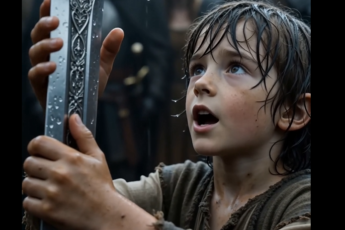
The kingdom of Veyrand had not known a night so still in forty years.
In the great castle of Hollowcrest, perched high above the silver river, the halls were silent but for the hiss of dying torches and the muffled weeping of servants. King Aldric the Third — called the Lion-Hearted in his younger days, when his sword had turned back three invasions and his laugh could be heard across the banquet hall — was dying.
The royal physicians had come and gone. The priests had come and gone. The astronomers had read the stars and left without speaking. Even the court’s famous sorceress, summoned from the far mountains at tremendous cost, had stood beside the king’s bed for a long while, touched his forehead, and departed with her head bowed.
“It is a sickness beyond the reach of any living hand,” she had told the queen, who was no longer queen but would soon be widow. “Make your peace, Majesty. By sunrise, he will be gone.”
And so the castle prepared itself for grief.
In the royal bedchamber — vast and vaulted, its crimson tapestries embroidered with the golden lions of the House of Veyrand, its marble hearth still smoldering, its stained glass windows catching the moon — the king lay dying beneath a mountain of ermine furs. His silver beard had grown long during his illness. His great crown rested on a velvet cushion beside his pillow, its rubies and sapphires dulled by candlelight. His scepter leaned against the bedpost like a forgotten thing.
Aldric drifted in and out of sleep. In his dreams he was young again, galloping across the wheat fields of the lowlands with his father’s hunting hounds at his flanks. In his waking moments he saw only the ceiling, and the shadows moving upon it, and the faces of those who loved him trying not to cry.
The hour grew late. The guards at the chamber door nodded at their posts. The queen, exhausted, had been persuaded to rest in the adjoining room. Only a single maid remained, asleep in her chair by the fire.
It was then that the door opened.
It did not creak. It did not groan on its iron hinges as it always had. It simply opened, soundlessly, as though it had been waiting.
A boy stepped through.
He could not have been more than eight years old. He wore a plain dark tunic of rough wool, a hood pulled low over his brow. His feet were bare on the Persian rugs. He made no sound as he crossed the great chamber. He passed the sleeping maid without disturbing her breath. He passed the dying fire and did not cast a shadow on the wall.
He came to the side of the king’s bed and stood there, small and still, and looked up at the face of the man who had ruled Veyrand for forty-six years.
“Your Majesty,” he whispered. “I can heal you.”
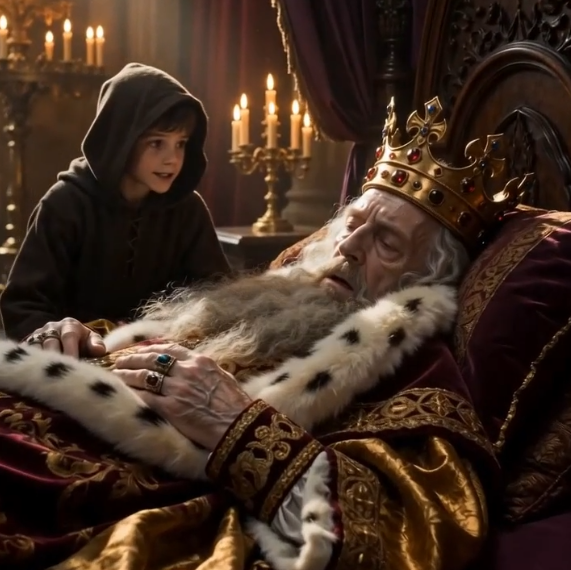
The king’s eyes opened slowly. They were glassy with fever and the long nearness of death. He turned his head against the pillow with great effort, and when he saw the child standing there, he did not understand, and for a moment he thought this too was a dream.
“Who…” His voice was a dry rasp, barely a sound at all. “Who are you?”
The boy did not answer.
He reached out with both small hands and took the king’s wrinkled, ring-heavy hand in his own.
And then the light came.
It began between their palms — a soft, golden warmth, like the first moment of sunrise when the sky is still the color of an old rose. It grew brighter. It pulsed outward in slow, rippling waves, washing up the king’s arm, across his chest, into his face. Where the light touched him, the grey of his skin gave way to color. The hollows of his cheeks filled. His breath, which had been a shallow and rattling thing for many days, deepened into something strong and certain. The fog lifted from his eyes.
Aldric felt forty years fall away from him. He felt the strength return to his hands, to his shoulders, to the old battle-scarred muscles of his back. He felt his heart beat — truly beat — for the first time in months.
He gasped.
He pushed himself up on one elbow, trembling, and stared at the boy with an expression of such stunned wonder that his own face seemed young again. The crown on its velvet cushion caught a beam of light and blazed.
“Child…” he breathed. “What — what are you —”
The boy smiled.
It was a small, sad, patient smile. The smile of someone who has done this many times before.
“Rest now, Majesty,” the boy said softly. “You have a little more time.”
And then — gently, without ceremony — he let go of the king’s hand.
The king sat up fully. He looked at his own palms. He flexed his fingers. He laughed — a single, astonished laugh that broke from him like a bird escaping a cage. He turned to call for the queen, for the guards, for anyone, to witness this miracle —
But when he turned back, the boy was gone.
The chamber door stood closed. The maid slept on by the fire. The candles had not even flickered.
In the morning, the news swept through Hollowcrest like a wind through standing wheat. The king was well. The king was better than well — he was restored. He walked the battlements at dawn. He ate three full meals. He held his grandchildren up to the light and wept with joy.
The queen fell to her knees in the chapel and did not rise for three hours.
The bells rang in every tower of Veyrand, and in every village down to the sea.
King Aldric spoke to no one of the boy for seven days. He thought, at first, he had dreamed it. But the memory was too clear, too warm, too real. On the seventh day he summoned his oldest friend — the knight-commander Sir Bastien, who had ridden beside him in four wars — and he told him everything.
Sir Bastien listened in silence. When the king had finished, the old knight’s face had gone very still and very pale.
“My lord,” he said at last. “There is a story. I have not thought of it in many years. My grandmother told it to me, when I was a child — and her grandmother told it to her.”
“Tell me,” said the king.
Sir Bastien drew a breath.
“They say that Death has a son,” he said. “A small boy who walks the world in a plain dark tunic. They say he loves his father, but he does not always agree with him. They say that now and then, when Death comes too early for someone — for a good king, for a mother with young children, for a farmer whose crops are still in the field — the boy goes ahead of him. Quietly. Before his father arrives.”
The king said nothing. The fire crackled.
“He does not save them forever, my lord,” Sir Bastien said gently. “He cannot. His father always comes in the end. But sometimes — sometimes — the boy buys them a little more time. A year. Ten years. Long enough to see a daughter married. Long enough to finish what they began.”
King Aldric looked out the window of his study, at the green fields of Veyrand stretching to the horizon, at the river catching the morning light.
“How long?” he asked quietly. “How long did he give me?”
Sir Bastien shook his head.
“Only the boy knows, my lord. Only the boy.”
King Aldric the Third, called the Lion-Hearted, ruled Veyrand for eleven more years. They were the best years of his reign. He reformed the courts. He ended the long feud with the southern kingdoms. He saw his grandson crowned prince. He planted an orchard with his own hands, and lived long enough to eat its fruit.
On the last night of his life, in the same great bedchamber where the boy had come to him long ago, the king sent the servants away and asked to be left alone. The queen, now old herself, kissed his forehead and closed the door softly behind her.
Aldric lay back against the pillows and waited.
He was not afraid.
After a long while, he heard the door open. It did not creak. It did not groan on its iron hinges. It simply opened, soundlessly, as though it had been waiting.
He smiled before he even turned his head.
“I wondered,” he whispered, “if you would come yourself.”
A tall figure stepped into the chamber — hooded, silent, patient.
But behind the tall figure, holding his hand, was a small boy in a plain dark tunic. He looked exactly as he had eleven years before. He had not aged a single day.
The boy looked up at his father. The tall figure nodded, once.
The boy walked to the side of the king’s bed, and this time he climbed up and sat on the edge of it, and he took the king’s hand in both of his own — gently, as a friend would.
“Are you ready, Your Majesty?” he asked.
King Aldric smiled, and his eyes were very clear.
“Yes, child,” he said. “Thanks to you — yes.”
The boy smiled back. And together, the three of them sat in the candlelight, and waited, until the light went soft and gold, and then softer still.
In the morning, the bells rang again across Veyrand.
But this time, no one wept for very long. Because the king had lived a full life — and a little more besides.